| OCR Text |
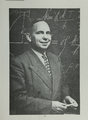
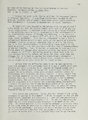
Show 61 A peculiar, but as it turned out, beneficial, error occurred in one of Eyring's early papers with Prof. N. F. K. Wynn-Jones on reaction rates.15 For the general reaction A + B + . . . the rate constant is now written as k' + Activated Complex, Kk/h - Ft/FAFB e-EO/RT. Orig- # inally F , the partition function of the activated complex, was written F*, but Eyring's secretary, Miss Lucy Darcy, when typing the paper, replaced the asterisk with a plus and minus sign in all the formulas since she did not have an asterisk on her typewriter. Eyring did not change the manuscript and when the printers saw the f sign on the paper they replaced it with the cross of Lorraine #. tinue using the cross in future papers. Eyring decided to con- It has since become the most prominent symbol in the Eyring reaction rate theory and whenever it appears one knows that the symbol refers to a property of the activated complex or the activated complex itself, One of Eyring's first applications of the new theory was made in l936. He turned his attention to the physical properties of liquids, particularly viscosity, plasticity, and diffusion, and he showed how absolute reaction rate theory could be applied to explain these phenomena. The results of this investigation were published in an important paper in the Journal of Chemical Physics.16 The paper contained an extraordinary idea that illustrates the creativity of Eyring. He pro- posed that liquids contain fluidized vacancies or molecular sized holes. He noted that to introduce a fluidized vacancy requires the same amount of energy required to vaporize a molecule. Using this simple model, he was able to explain simply the law of rectilinear diameters of Cailletet and Mathias, that is, the mean density of a liquid and vapor from the melting point to the critical point remains constant except for the small |