| OCR Text |
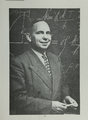
Show I 72 that at low temperatures they were more voluminous. By applying pres- sure in the high-temperature range the volume of the reactants decreased and luminescence resulted.47 The application of the Eyring rate theory to bacteria] luminescence brought together in a unified way the mechanism through which temperature, pressure and anesthetics affect biological reaction rates. Before l942, the three factors were thought of as acting independently in such reactions. 48 What was an academically interesting problem (luminescent bacteria) could now be used to study numerous physiological questions, including intercellular reaction rates. During the next three decades, Johnson and Eyring collaborated on many physiological reactions important in biology and medicine. Certainly, the research of the war years produced a very well rounded scientist in Henry Eyring. He had made tremendous strides in the application of his absolute rate theory and could see further fruitfulness in his research. His accomplishments in science received con- siderable recognition at Princeton. In addition to the AAAS prize in l932, he was given membership in one of America's oldest scientific societies, the American Philosophical Society, in l94l. Three years later he became a member of the American Association for the Advancement of Science and in l945 he was elected to the National Academy of Science, the most prestigious of U.S. scientific societies. With such experience and attainment it is little wonder that Professor Hugh Taylor and Princeton would ask Eyring to undertake a project which at first seems foreign to his interests and background. In late 1944, he was appointed acting director of the research program of the Textile Foundation and the Textile Research Institute. During the war |