| OCR Text |
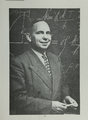
Show 96 problem. His mind also had the ability to retain work on many problems and at a moment's notice, his mind could focus on the central issues of a problem.27 Eyring, as his students and colleagues can testify, had a tremendous ability to create models for scientific problems, and with these models (right or wrong) much new insight could be gained into the problem.28 He, with a moment's relaxation at home, at the office, walking to or from school, at his hotel room, or on a plane would scribble notes on an envelope from the day's mail and soon be bubbling over with new ideas on how to tackle a difficult problem with which he or his students were concerned. Professor Hugh Taylor added this comment about Eyring's creativity: 0f Eyring one must record that his approach to every problem is fresh, original and very frequently unorthodox. He tends to discover the facts of science for himself rather than to read what others have found. For Eyring, a scientific fact becomes a fact when he has discovered it and discovered why it is a fact.29 For Eyring, it was not only a remarkable mind and an unquenchable thirst to know, but great determination and hard work that made him so successful. In May, l957, he was gone only two days, one day to lecture at Iowa State University in Ames, and one day at the laboratories of General Motors Corporation in Detroit. At General Motors, he was invited to speak on the significant structures of water and to tour the new labora- tory facilities there. In June he was away from home for fifteen days on two separate trips. On the first trip, he spent four days in Cleve- land, then he left for Houston, Texas to attend the scientific advisory board meetings for the Robert A. Melch Foundation. In l954, he had been appointed to this board along with such distinguished scientists as Dr. A. P. Beutel of the Dow Chemical Company, Freeport, Texas; Dr. Detlev |