| OCR Text |
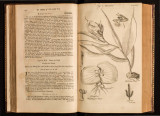
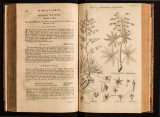
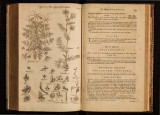
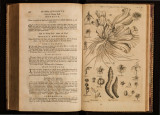
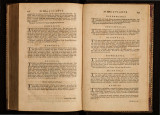
Show 544 The Hiflory of P L A N T S. C 0 LUTE A. T HE pod is inflated, and opens at the upper part of the bafe,; the calyx is bilabiate. Colutea Joliis obveife cordatis, caule ar!Joreo. The tree Colutea, with obverfely, cordated leaves. The root is brachiated ; the trunk is woody and hollow : the branches are numerous ;. the leaves are long, pinnated, and of a bright green : the pinnre lhort and hairy underneath : the flowers are very numerous ; they hang on long pedicles in clufiers, and are moderately large and yellow; the pods are inflated in manner of a bladder. It is a native of Italy. It grows on the top of Vefuvius, where there is no other vegetable. C. Bauhine calls it, Colutea veficaria. The other fpecies are, I. The lhrubby, purple-flowered Colutea. 2. The dwarf, Syrian, purple Colutea. DOLICHOS. 1 I"1' •' T HE bafe of the vexillum has two· oblong, parallel, ~allous 'bodies, pre!ling the alee. This genus is nearly allied to the Phafeolus ; but in that the Carina is fpi ral, and it is not fo in this. 'I ) Dolichos leguminibus ovato-acinacijormibus, fiminibus 'ovatis, hiio arcuato verfus a/tam extremitatem. The ovato-acinaciform, podded Dolichos, with oval feeds, ridged to-ward one end. The root is fpreading; the 1l:alk is firm and woody, but climbs upon trees, and any thing that is near it: the leaves are large, broad, and pointed, and refemble thofe of the common Phafeo~us: the flowers are large and white,; the pods are long; the feeds are like thofe 'of our kidney-beans, but have a ridge near one end. It is a native of Egypt, where it is ufed in fodf:L J. Bauhine calls it, Phafeolus lablab Alpini. The other fpecies of Dolichos are, r. T.he purple-flowered, flender-podded Dolichos. 2. The dwarf, yellow Dolichos. PHASEOLUS. THE carina of the flower, as alfo of the fiamina and fiyle, are twified fp irally. P hqfeolus corollis coccineis. Tha flarlet-Jlowered P hafeolus. The root is fibrous; the fialk is weak, climbing, and four or five feet long; the leaves fiand three on each pedicle ; they are broad at the bafe, and te rminate in a point ; the flowers are large, and of a bright fcarlet. It is a native of America. Cornutus calls it, Phafeolus puniceo flare; Morifon, Phafeolus Indicus flore coccineo. The other fpecies are, r. The common, garden Phafeolus, or Kidney-bean, with Ws feveral varieties in the colour of the feeds, from which Tournefort and others have made feveral fpecies. 2. The dwarf, black, Italian Phafeolus. 3· The Ceylon Phafeolus, with radiated pods. 4· The ivy-leaved, woolly-feeded Phafeolus. S· T he broad-fruited Phafeolus. 6. The yellow-flowered, Egyptian Phafeolus. 7· The narrow-leaved Phafeolus. 8. The little-leaved Phafeolus. 9. The yellow-podded Phafeolus. IO. The cochleated-flowered Phafeolus. 1 1. The vetch-leaved, ovalpodded Phafeolus. 12. The' very long-podded Phafeolus. 13. The dwarf, red-flowered, African Phafeolus. 14. The purple-flowered, tuberous-rooted, American Pha-feolus. '!be Ri.ftory of P L A N T S. 545 f~olus~ 'r S· The yellow, firumous-rooted Phafeolus. 16. The great-podded, Ame-ncan Phafeolus. I7. The great-flowered American Phafeolus . 18 Th h · Ph r. I . h . . d d ' • . e airy a1eo us, wit JOmte po s. r 9• The falcated -podded Phafeolus 20 Th midal-fpiked Phafeolus, with red and black feeds. 2I. The rou~d-lea~ed e J!;~fea Phafeolus. 22. The hairy-podded, American Phafeolus. ' p p ' Clafs the Seventeenth. Order the Third. Divijion the 7hird. j. ,( Diadelphia Decandria, . with bilabia~ed cups ; the ftigmata not hoary, and the flamzna not growzng together at the !Jqfe. · · U LEX. ('' THE , calyx is com pored of two leaves ; the pod 'is fcarce longer than the cup: : The plants of 'this genus have been confounded with the Genifta and Genill:a Spartla by authors. · : · , "' Ulex folio fob fingulis Jpinis fubulato-plano· acuto. 7be l!lex, with a .p/a'!o-:fubulated, acute leaf under every ./Pine. . I • The root is long and divided; the trunk ,is firm, woody, and covered with a brown bark ; the young branches are gJ:!een, flexible, and befet with numerous thorns : the thrub grows to three, four, o~ more, feet high; the leaves are fmall, and fall off .very foon ·; the flowers ate large, yellow, numerous, and beautiful. ·· It is common on our heaths. C. Bauhine Cfllls it, . Genifta fpinofa major lo~giori-· bus aculeis. f The other fpecies are, 1. The arborefcent, larger-leaved, African Ulex. 2. The red-flowered Ulex. 3. The .lhorter-fpined, common Ulex. 4· The flender-fpined Ulex. 5· The (mall-flowered Ulex. r .s ( ! i ,. n • '-. '.C I T Y S U S. ,1 ·' t' t ... l l J J ,. ~~ ,) '1' (..I T H E calyx is bilabiate ; the pod is attenuated at the bafe. This genus comprehends the Cytifus of Tournefort, and the Laburnum of Rivinus. Qyttfus foliis ovato-oblongis, racemJs fimplicibus pendulis. The ovato·oblong-leaved Cytifiu, with jimple, pendulous clu.flers. 3tbt not tl:tnlting · l/5ean 'ltrtfott. ~ The root · is fpreading; the tree. grows to five and t~enty feet high: and is very ramofe : the wood is firm and hard ; the l?a~k of· the you~g branches is 1green : the leaves ftand 'on hairy pedicles ; they are two inches long, and more than an inch broad. obtufe at ·the end, arid hoary underneath : the flowers are moderately large and yel-low; they hang in clufiers, on long pendulous peduncles. · , · It is a natiwe of Italy. C. BauhiQe calls it, Anagyris .non fretidk hiajor five Alpina ; · Tournefort, Cyti{us flare racemofo pendulo. ·. The other fpecies are, I . The reddifh, hoa~y Cytifus. 2 •• ~:rhe ; long-podded,' hoary Cytifus. · 3· The grea·r, hoar.y, yellow Cytifus. ' 4· The fmall-leaved, hoary Cytifus. 5· The roundi!h-leaved, ihort-pedicled Cytifus. 6. The fmoo'th, green Cytifus. 7· The narrow, complicated, • hoary Cytifus. 8. The .lhort, pendulousflowered Cytifus. 9· The purple-fpiked Cytifus. I o. The filvery, African Cytifus. 1 r. The prickly Cytifus, called trifoliate acacia. I2 . The dwarf, narrow-leaved, w \ .,, " ,. I o • 6 Z .filvery |