| OCR Text |
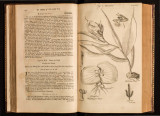
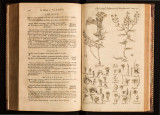
Show 2g6 'fhe Hi.ftory of p L A N T S. will row to fix or ei ht feet in length. The bark of the main fialk is of. a greyilh .. b g that of the yo~ng {boots green. The leaves fiand fingly on large pedtcles ; they rowfn, k. d f 1 fig re but too much pointed at the end, and have two long au~ a·r e o1 a hm b0 fc ovaT he uf lo'w ers grow in clufters; they are 1r. ma II , an d o f an ·11 1i ll 1 me , but rtcu re at t e a e. . h. h 1i d h bl d d of a ver beautiful purple colour; the bernes, w tc 1Uccee t em, are ? ong a~ re . I t · fiy "th s 1·n watery places and among hedges. C. Bauhme calls It, So .. IS requent WI u ' · lanum fcandens five Dulcamara. ' 3• Solanum ~aule inermi. harbaceo~ I Joliis ~inn~tis incijis. The herbaceous Solanum, wtthout prtckles, wtth ptnnated, ferrated leaves. 't ito be Atpple. The root is compofed of a multitude of white fibres: the ftalk is ~oundilh , hollow; h · k' and procumbent in great part : it grows to three or four feet long, and airy, wea , r d · · r. d' h ufually keeps the upper half ~recr, the reft on the &roun ; 1t IS very ~am?1e, an. t e branches long. The leaves are pinnated; each conhfts of three. or fom patr of pmnre, which are of an oval figure, ferrated round the edges, and an mch long,. affixed to a middle rib, terminated. with an odd leaf at the end : they are fomewhat hatry, and of a deep duiky green colour. The flowers do not grow from the alre of the l~aves, but ~rom the intermediate fpace ; they ftand ten or twelve togethe~, ~ach on a pedtcle of an ~nch long; they are moderately large) and yellow. The frmt IS very large and beauttful, of a yellowHh-red colour. . It is a native of both the Eaft Indies and Amer.ica, and is very common m .our gar-dens. The fruit is eaten by many people, but It ou&ht to be. thoroughly npe. C. Bauhine calls it, Solanum pomiferum fruClu rotunda finato molh; Tournefort, Lyco~ perficon Galeni. 4· Solanum calycibus aculeatis, foliis ovatis integerrimis •• r tomentojis. ' '( . The prickly-cupped Solanum, with oval, woolly leaves. • I I The root is compofed of a multitude of fibres, and does not defcend very deep into the ground : the ftalk is ufually lingle~ round, reddifh, and covered with a foft .down, which is eafily rubbed off; it is of the thicknefs of a finger, not more than e1ght or ten inches high, but branched from the very bottom to the top. The leaves are very large, often four inches and a half long, and more than three broad ; they are deeply finuated about the edges, and they ftand on very long and thick pedicles ; the colour of the leaf is a dark green; but the whole ftalk o( the plant, the pedicles of the leaves, and even the middle rib, is ufually of a blood red; there is always a loofe down. upon the leaves, and the middle rib is fometimes arm~d with thorns. The flowers gro~ oppofite to the leaves, ufually fingle, fometimes two or three together ; the cup IS armed with red fpines: the flower itfelf is large, naturally of a purple colour, ~ornetimes whitilh. The fruit is roundiih, o~al, or of an oblong figure, approachmg to that of a cucumber, of a fine purple, or greeniih, colour. It is a native of Africa, and of fome parts of America, but we have it in our ga:dens. Tournefort cans it, Melongena fruClu rotunda; C. Bauhine, Solanum pomtferum fruClu oblongo ; Dodonreus and others, Mala infana ; but, notwithfianding that terrible ~arne, the Italians eat the fruit, as they do that of the former fpecies, without any injury. , · The other fpecies of Solanum are very numerous in nature, but not nearly fo many as they appear in the writings of the botanical authors, who have frequently made fi x or eight fpecies out of one: an infiance of this we have in the 6dl: fpecies of Solanum defcribed here, the moft common of all the kinds, both here and in many other places, and almoft univerfal throughout the world, but with fame variation, as, r. In the Eaft Indies ; it's leaves are even at the edges, and fn;10oth, and the fialks round. 2. In Guinea the fialks are angular, and the leaves fmooth. 3· In Virginia the 1l:alks are angular and dentated, the leaves iinooth, and bent back. 4· In our own country the ftalks are round and hairy, and the leaves finuated, and vtry little hairy. 5· In Judrea the ftalk is fomewhat prickly, and the berries fornetimes yellow. Thefe are but very trifling variations, when we confider the plant in fo many different climates ; yet every one ofthefe vari~tics has been defcribed1 by one author or other, under the name of a ' di!linCt The Hijlo>"y of P L A N T S. 297 difiincr fpecies, and thus fix fpecies made out of what is truly but one. Dillenius has called the Indian kind, Solanum procerius patulum vulgaris fructu; Boerhaave calls the Guinea kind, Solanum fruClu nigra umbell'atb; and fo of the reft. This may explain the reafon why, in many genera, the fpecies mentioned here are much fewer than .fiand ufually in authors. The more fin gular and diftinc.l: kinds, befide the above defcribed, are, 1. The common Potato. 2. The borrage-leaved, prickly Solanum. 3· The cordated-leaved, prickly Solanum. 4· The fhrubby, narrow-leaved Solanum. 5· The prickly, procumbent Solanum. 6. The yellow-fpined, American Solanum. 7· The great, woolly, prickly Solanum. 8. The finuated-leaved Solanum, with ptuple fpines. 9· The pomiferous, foft, woolly Solanum, with no fpines. 10. The long-fruited, finuofe-leaved Solanum. 1 1. The bay-leaved, prickly Solanum. I 2 ." The mullein-leaved Solanum. 13. The almond-leaved Solanum. I4. The henbane-leaved, climbing, prickly Solanum. I 5· The blite-leaved, ihrubby Solanum. I 6. T he angulated-leaved, greatfruitedJ fhrubby Solanum. 17. The prickly, long-fruited Solanum. PH Y SA LIS. T HE calyx is a fmall, pentagonal, ventricofe perianthium, formed of a fingle leaf, · divided into five lhort acuminated fegments at the edge, and permanent. The corolla confifts of a fingle, rotated petal: the tube is very fhort : the limb is large, plicated, divided into five fhort, acute fegments : the ftamina are five very fmall, fubulated filaments: the anthera~ are erect and connivent : the germen is roundilh : the ftyle is filiform, fomewhat longer than the fiamina : the fiigma is obtufe. The fru it is a fmall berry, roundiih, and containing two cells; it is fituated in the bottom of a large, hollow, coloured, and inflated cafe, which is formed of the perianthium, extended to tho(e dimenfions, and clofed at the extremity : the receptacle is kidney-fhaped, and duplicate : the feeds are numerous, kidney-ihaped, and compre1fed. .I. P hyfalis caule fimp/ici annuo, foliis integerrimis geminatis, jloribus folitariis. The Jingle, annual-j}alked Phyfalis, with geminated leaves, and jingle flowers. The root is long and ilender ; it creeps under the furface, ahd fends out a number of fibres. The ftalk is round, ilender, fomewhat hairy, often red, and always jointed at fmall difiances ; at every joint there ftand two ]eaves; each has it's own long pedicle; they are of an oval figure, obtufe at the end, and of a yellowilh-green colour, not ferrated at the edges, a little hairy, fcarce perceptibly fo, and of a pale yellowifhgreen colour. The flowers fiand on ilender, hairy pedicles, of three quarters of an inch long, growing from the alee of the leaves; they are large and white; when they are fallen, the cup fwells to the bignefs of a walnut, and becomes red, pentagonal, and hollow, like a bladder; the berry is placed at it's bottom, and is red, and of the bignefs of a fmall cherry. It is a native of Germany, Italy, and France; we have it in gardens. Tou(nefort calls it, Alkekengi officinarum ; C. Bauhine, Solanum veficarium. 2. Phyfalis annua ramoji.flima, ramis teretibus pubifcentibus, geniculis nodojis. The branched Phyfalis, wz"th round, hoary Jlalks, and knotty joints. ~ttcgtnian <Wltn::= ter <!betrp. The root is fibrous: the ftalk is round, hairy, jointed, and protuberant at the joints, a foot and a half long, but in great part procumbent. The leaves are oval, hoary, and oblong; the flowers are fmaller than in the former, and the fruit is yellow. It is a native of Virginia. Morifon calls it, Solanum veficarium procumbens Vir-ginianum folio lanugino!o. · The other fpecies are, 1. The Indian, beet-leaved Phyfalis. 2. · The fmall-fruited Phyfalis. 3· The li ttle, green-fruited Phyfa lis. 4· The large, American Phyfalis, with deeply finuated leaves, brought over by Houfton. 4 G Clafi |