| OCR Text |
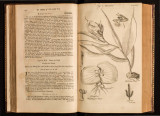
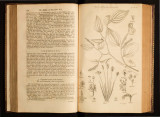
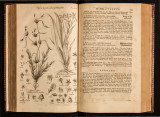
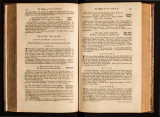
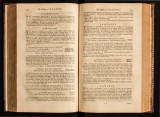
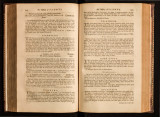
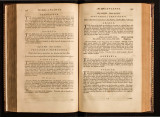
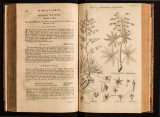
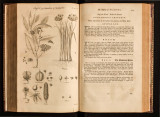
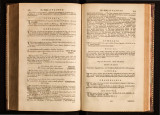
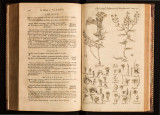
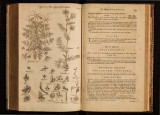
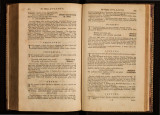
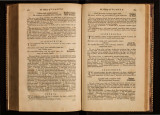
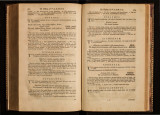
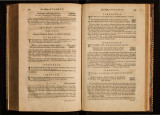
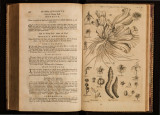
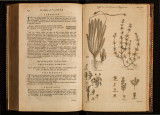
Show 186 The Hiflory of P L A N T S. AN T H 0 L y z A. The root of this plant is compofed of .two flefhy bulbs, one lying over the. other,' and both furrounded with two or three ret)cular membranes. The leaves are eight or ten inches long, and not more than two thirds of an inc;h in breadth ~ the~ are o~ a bluifh or greyifh-green colour, and. a:e broadeft at the bafe, ~nd ten;unat.e m a pomt. The ftalk rifes from among thefe ; 1t IS ten, twelve, or more, u~ches m height, round, of a pale green, of the thjcknefs of a large packthread, and ha1ry .. The flowers :ll:and in a long feries ~t the top, fix or eight one over another, ~t fome d1ftance. They are large, and of an extrcamly beautiful crirpfqn c;olou:. . This is a native of lEthiopia, but we have it m fame of. our ftoves. C~mm~lm calls jt Gladiolo 1Ethiopico fi~:nilis planta, anguftifolia, caule hufuto, flare rublcundiffiqlO; a~d Breynius,Gladiolus flQribus rietum referentibus, coccineis, fuprema lacinia eretla fifiulofa. I R I S. T H E Iris has no calyx; there are only fome alternate, fimple, imbricated, permanent fpath<e, which feparate the flowers. The corolla is divided into fix parts: the petals are oblong and obtufe : the' th~e~ ,exterior ones are reflex, the interior are erect, and more acute ; they all adhere by their ungues or bafes. The fiamina are three fubulated filaments, lying on the reflex petals: the anther:;e are oblong, firait, and depreffed ; the germ en of the pi.llil is oblong, and placed beneath the receptacle; the fiyle is fimple, and very il10rt; the fiigma is very large, and divided into three fegments, which re{emble peta)s; they are broad and reflex ; their apices are bifid. The fruit is an oblong angul~r capfule, compofed of three v~lve$, app formed into three cells, in each of which is contained a number ot large feeds. The nectarium, in fome fpecies of the Iris, is a longitudinal, hfliry line on the bafe of the reflex petals ; in others it is formed of three melliferous fpots on the external part of the flower, near the bafe. The capfule in fome is trigonal, in others it ia hexagonal. This genus comprehends the Iris, the Xiphion, the Sifyrinchium, and the Hermodac: tylus of Tournefort. The parts of fruClification in all thefe are the fame, the root and leaves only difter. In the Xiphion, the root is bulbous, and the leaves are fubulated. In the Sifyrinchium, the root is compofed of two bulbs laid one ori the other. In the Hermodac:tylus, the root is tuberous, and the leaves tetragonal· and in the Iris I . fl 11... , , ' t 1e root ~s ewy, oblong, and creeping, and the leaves are enfiform. J, Iris corollis bar6atis, cau/e foliis longiore multijloro. The bearded-flowered Iris, with many flowers on a jlalk longer than the leaves. f!ornnton JFI olllcr ne JLuce. . Tl~e r~ot of the cot?mon Ir~s is large, :flelhy, tuberous, and creeping; it is of an mch m dmm.eter,. and .It. c:eep~ JUf\: ~nder, or upon, the furface of the earth, with numerous rami.ficat10ns JOmmg m an Irregular manner one to another. It is brown on the outfi~e,. white w~thin; very juicy, and of a very acrid and pungent tafie. The leaves anfe m tufts, e1ght or ten together; they are near two feet long, about an inch b1·?ad, and of a pale green colot,Ir : they are broade11: at the bafe, and terminate in a po1?~· The whole clufier of leaves unite at the bafe, receiving one another into their cavtttes. From the center of thefe leaves rifes a fialk of near three feet in height, round, fucculent, a!1~ gr~en, .but covered with a whitilh dufl:, that eafily rubs off: there ~re fl~e or fix JO!~ts m tlus fl:alk, at each of which fiands a fingle, fhort leaf, and often 1t dtvtdes at top mto two or three branches, on each of which there are two or three of thofe ihort leaves, which are affixed by no pedicle, but furround the fialk at the bafe. The flowers fiand on the tops of thefe fialks; they are of a deep violet purple, and very large. T~is ~s a nativ~ of ~orne pa~ts of Germany ; it is common with us in gardens. vCw:· laBcaeuah. me calls 1t, Ins vulgans Gennanica five f·v lvefiris. J. Bauhine , Iris vulgaris 2. Iris The Rijlory of P L A N T s. 2. Iris radice duplice 6ulbofa, folils a?zgujlis mollibus. The double !Ju!bous Iris, with fift, narrow leaves. This is one of the fpecies of Iris, commonly called Sifyrinchia. The root is compofed of two moderately large bulbs, one lying upon the other; at the time when the plant is in flower, the upper one is larger, and tnore fucculent, and the under one flaccid: the tafie is fweetifh and pleafant, and the root efculent. The leaves are long, and very narrow ; they grow feveral together from the fame root, and ufually lie upon the ground : they are 11:riated, foft to the touch, tender as the leaves of garlick, and of a deep green colour. The ftalk is round, fmooth, and firm, about fix or eight inches high : the flowers are large, and of a fine deep blue, with three fpots of yellow ; four or five of them grow on every ftalk, but only one opens generally at a time. This fpecies is a native of Spain ; we have it frequently in our gardens, where it ftands very well in the open beds. C. Bauhine calls it, Sifyrinchium majus flare lutea macula notato. Clufius, Sifyrinchium majus; and J. Bauhine, Iridi bulbofa:: affinb fifyrinchium majus. 3· Iris tuberofa radice, foliis tetragonis. 'lbe tuberous-rooted and tetragonal-leaved Iris. This is the fpecies of Iris, which Tourhefort has formed a feparate genus of, under the name of Hermodaetylus. It's root is tuberous, and compofed of feveral oblong and thick pieces, odly joined together, fometimes all united to a kind of head, and refembling four or five fingers ; from this there rife three or four leaves, near two feet in length, and very Oender; hard, rigid, and of a quadrangular fhape, terminating in a lharp point, and, when full grown, often drooping their tops to the ground. They are of a blui!h-green colour, and at the bafe they are fmaller than elfewhere, and furrounded with three or four membranes. The ftalk rifes in the midfi of thefe; it is flender, rounded, and ftriated; two leaves firmly furround it fi·orn the· bafe almofl: to the top, receiving it into their finus's: toward the top there are two knots in it, placed near one another ; thefe have each riling fi·om it a membranaceous, hollowed leaf; the lower of thefe is the larger. The flower is moderately large : the three reflex petals are of a fine, deep, gloffy black; the others are greeniib, or whitiib, with a tinge of black. This fpecies is a native of Egypt and Arabia; we have it in fame of our gardens, but it is not common. C. Bauhine calls it, Iris tuberofa; and J. Bauhine, Iris tubero{a Belgarum. 4· Iris Joliis margine conniventibus corollis imberbibus. The hollow-leaved Iris, with the edges almojl meeting. 1J5Iue but~ bous 'JJrts. This is one of thofe Iris's called, by Tournefort and others, Xiphion. The root of this fpecies is large and roundi01, flefhy, and covered with feveral black membranes : the leaves are large, broad, and carinated, or hollowed; the middle of the hollow is u(ually covered with a kind of filver-like drops. The edges almofi meet with one another, fo as to give it the appearance of a round, hollow leaf, like that of a leek. The ftalk is fufficiently thick, but infirm and tender, and is u(ually furroundcd with four or five leaves: it grows to ten or twelve inches high, and fometimes has only one, fametimes two, flowers, rarely more on it. Thefe are large, and very beautiful, of a deep violet purple; fometimes indeed paler, and fometimes white, under which variation ' the plant has been defcribcd as a difl:inct fpecies, and even when pale red, or firiated, as others. This is a native of Spain, but it fucceeds very well in our gardens. C. Bauhine calls it, Iris bulbofa creruleo-violacea. J. Bauhine, Iris bulbofa tota violacea vel Ca!rulea; and Tournefort, Xiphium c.eruleo-violaceum. Thefe four fpecies may give a difl:inet idea of the principal di£linCI:ions of the genus, as they are [eleCted from among thofc di£linguifhed by authors, who have paid more regard to the roots and leaves of plants, than to their parts of fructii1cation, into different genera. The other fpecics of the Iris are very numerous, and their varieties defcribed |