| OCR Text |
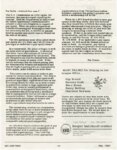
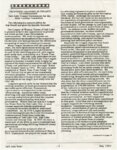
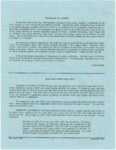
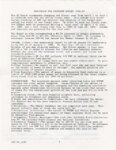
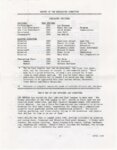
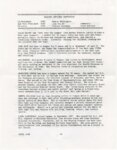
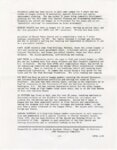
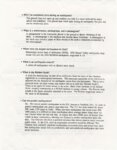
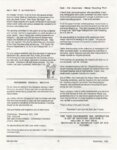
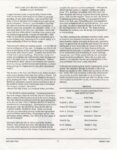
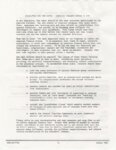
Show underlain by coarse sand and gravel, especially for distant (50 to 250 km) eanhquakes. For distant earthquakes, the ground motion levels that occur at the soft sediment sites arc expected to be 6 to 10 times greater than at rock site, for periods greater than about 0.2 s. • Some other serious problems accompanying large Wasatch Front earthquake will include: soil liquefaction, landslides, rock falls, and broad permanent tilting of valley floors-possib ly causing the Great Salt Lake or Utah Lake to inundate pan of Salt Lake <;ity or Provo. Los.1 Estimates • In a magnitude 7.5 earthquake on a central part o~ the Wasatch fault, Utah should expect damage to buildings to exceed $4.5 billion in Davis, Salt Lake, Utah and Weber counties. This may represent only 20% of the total economic loss. rt,, f • Moderate-sized earthquakes producing a "direct hit" to one of the Wasatch Front's ~ajor cities could also produce major damage: more than $2.3 billion for a magnitude 6.5 earthquake-a nd more than $830 million for a magnitude 5.5 earthq~ake. • Unreinforced masonry buildings (for example, brick homes built before 1960) are particularly vulnerable' to ground shaking and are expected to account for 75% of the building losses. The Wasatch Front area has a sizable inventory of other structures not built with earthquake resistant design that will be seriously damaged. • Surface-faulting, and other ground failures d_ue to ground shaking during a large earthquake, will cause major disruption of lifelines (utilities, water, sewer), transportation systems (highways, bridges, airports, railways), and communication systems. • As a result of the geographical concentration of state-owned buildings-an d their limited seismic resistance -losses from a large Wasatch fault earthquake could easily reach 30 or 40 percent of replacement value. (Schools, hospitals, and fire stations were not studied.) • A 1976 study by the U.S. Geological Survey for a worst-case earthquake on the central Wasatch fault estimated 2,300 fatalities (assuming no dam failures), 9,000 injured, and 30,000 homeless. The experience of the 1988 Armenian earthquakeand more up-to-date engineering judgment about the collapse potential of many structures in the Wasatch Front area-suggest s the 1976 fatality estimate is low. |