| OCR Text |
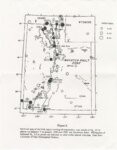
Show central part of the fault zone-r anges from a maximum of 415 years to a minimu m of 340 years. For these segments, the elapsed time since last rupture has been longest on the Brigham City and Salt Lake City segments (3,500 and 1,500 years, respectively) (Fig. 7). The most recent surface-faulting earthquake on the Wasatch fault occurred about 400 years ago on the Nephi segment. • Historical main shocks of estimated Richter magnitude 4.0 or greater in the Utah region are shown in Figure 8. The historical sample includes at least 15 indepen dent mai:n shocks that have had an estimated Richter magnitude of 5.5 or greater. • The largest historical earthquakes in the Utah region have been the magnitude (M ) 6.6 Hansel Valley, Utah, earthquake of 1934 and an earthquake near Richfield, s Utah, in 1901 that had about the same size (Fig. 8). • Moderate, potentially damaging earthquakes without surface rupture (magnitude 5.5 to 6.5) occur on average once every 6 to 7 years somewhere in Utah. Because of their broad distribution (Fig. 8), such eanhquakes are a fundamental source of seismic hazard throughout Utah's main seismic belt. • The map pattern of.10,732 small to moderate-sized earthquakes (up to magnitude 6.0) located by the University of Utah since mid-1962 (Fig. 9) emphasizes the nearly statewide extent of seismic activity in Utah. Seismicity prcdomi.qates, howeve r, along a roughly 200-km-wide zone defining the Intermountain seismic belt. Ground-Shaking Hazard • In any 50-year time period, there is a 10 percent probability that the levels of peak horizontal ground acceleration and velocity at sites underlain by firm sediments will exceed 0.25 g and 18 cm/s, respectively, along the Wasatch Front. • Based on recordings of distant nuclear explosions·in _Nevada, it is known that sediment properties in Salt Lake Valley can produce substantial geographical variatio n in the level of ground motions. Mean spectral estimates of low-amplitude ground motion values arc increased by factors of 6 to 10 or more in some sections of the valley, compared to hard rock, for the period range 0.2 to 3.0 seconds. The implica tion of such large site factors is that an earthquake of a given size at a giv~n distanc e is likely to be more destructive in the Salt Lake area than in, say, the Los Angele s area. • Because of the nature of geologic site conditions in Salt Lake Valley, the ground shaking hazard to high-rise structures sited over deep and soft valley sediments (fine sand and lake-clay deposits) is likely to be enhanced compared to the hazard at sites |