| OCR Text |
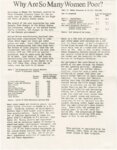
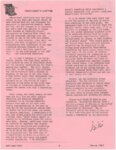
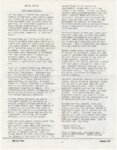
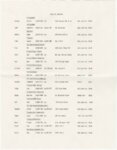
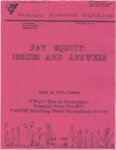
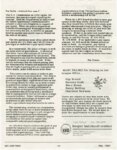
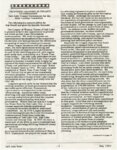
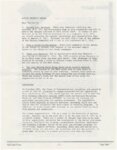
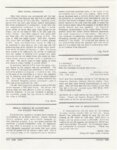
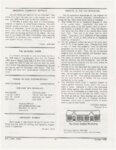
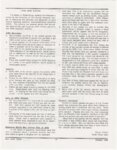
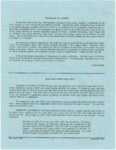
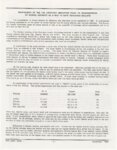
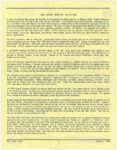
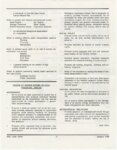
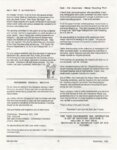
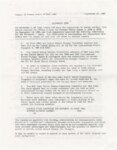
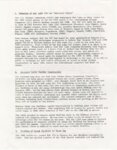
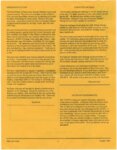
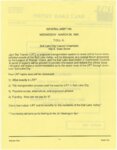
Show PAY EQUITY One of the f:iI:Jt 3tep3 in effecting change in oru society is to become informed. With the May ~tud y on Pay Eq llity, ve all have an oppoi-tunity to con.sider vhat ve think, individually and collectively, about pay eq uizy,, 3ometimes called comparable vorth. The study material consists of a pamphlet and tvo informative sheet3 of data. The pamphlet,, Pay~q uit.1-: bsue3 and Ansv·e rs .• va:, publlihed la:Jt year by the L WV Education Fund. It contains a good overviev for thought vi.th pros and corus. The i.uformati.o n sheeu are from the National Committee on Pay Equity. They contain detai.Js of pay equity events in tvo states, Wahington and Minnesota. The W6.!Jhington fact:J are especially important to Utah.us because a pay equity ~tudy i!J currently being done for Utdh state jobs by ArthllI Young, an indepen.dant corusultant. With the recent lack of state money and the difficult funding decisions facing the Leg:i!Jlature already, I vonder if U ta.h may face the 3am.e difficuliti.e3 in the future 8.5 Wa5hington ha5 alieady suffered. Because that state failed to fllD.d adjustments in ~a.Imes to achieve pay eq uily, it cost the state of Wa3hington over 25'% of it s 3tate payroll to correct the problem after losing in court_ In contrast, notice that the respon:}iveness of the ~tate of Minnesota to pha3e in pay equity o"rer fom yea.rs only cost that state 4% of it's annual pay.roll. 1 It is interesting to note, vhen reflecting on the stand tat.en in Utah and in Washington, that forecasts of economic disaster have been predicted each time steps hav-e been taken tovard ma.king key reforms in our employm.entJeconomic structure in this country including the a.b oli.tion of ~la.v ery and child labor lavs _ But another important factor is that the U _S. Supreme Court a.lread y ha~ indicated that it is not per.m.issible to continue to d~crimi.no.te j'u!Jt becta:U:Je it co:;t, too much to eliminate that discrimination. One of the argmn.ents agaircn pay equity is that it vill. re:rnlt in the estttbfuhm.ent of government v-age-setti.ng boards. There is ab.:mlutely notbin.g in the concept of pay eq-uity that suggests that this vould be even a remote po~::Jibility. The concept of pay equity me~ Salt Lak:e Voter that emvlonrs should i,ay their emvloyees on nondi:Jc:rim:ino.tory bo.:Ji:J_ 11 doe:, not meo.n. that all employers vho make vidgits must pay their employee:s the 38.JD.e. Nor -vill pay eq llity inte1fere with union-negotiated Vat!e settlemen~ or seniority :systeJ.U3 _ In fact., many unions already are including pay equity in their labor negoti.6.tion:J. ft. What kind of pay equity activities are occurring? Pay equity efforts have been most successful at the state and local govellilD.ent levels. Minnesota, for example has alread:,r moved a.head to implement pay equity~ veil. Nev York State completed one of the most exten:,:ive job evaluation!J ever undertaken by a public emplo:,rer--lookin.g at both race and sex vage d:i!Jprnties--and tlten moved ahead to allocate funds for the first pha3e of implementation. In :mme place:J, vhere it h~ been impossible to convince a state to implement pay equity volunta.rity, lav suits ha?"e been filed. To date, the largest of these suits Va3 the one filed by the Americ8.D. Federation of State, County and Municipal Employees (AFSCME) a.gain.!Jt the state of Washington. The lavsuit.,. vhich vas finally settled out of court, appears to have been the focal point for the tremendous amount of attention nov being paid to th.i3 issue. Although the AF SCME suit has been settled,, there ue other suits pending. The Am.eric~ Nurses Association is suing the state of Illinois, and AF SCME is tlbo :ruing N a:Jsau County in Nev York.. The Se:rvice Employees International Union has been baigsining villi the mayor of San Francisco over pay equity for vhat seems like forever. SEIU h~ 8.130 filed :nrit a.gainst the state of California on behalf of the state employees, vhom the union respesents. At the federal level, the House of Repre3entative3 has passed legislation r-aUing for tt study of the federal vage structure. The Senate has yet to take up that legislation_ But the Reagan Administration ha3 con:Jistan.tly rejected tlte concept of pay equity, and those federal agencies that have respon.3ibility for implementing federal employment policies and enforci.ng federal anti-discrimination la.vs have not i.n.teipreted them to encompass the concept of pay equity_ coldn.-ui. -3 - Oll , ~ 4 May 1987 |