| OCR Text |
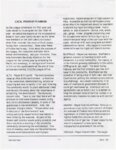
Show FUNDING It is critical that sufficient funds are allocated for the Moynihan bill if welfare reform is to work. Funding for S. 1511 is projected at $2.3 billion over a five year period as compared with the House's $5.7 billion over a five year period. Without adequate funding, such as that provided in the House bill, the League is concerned that great expectations could be set without providing the funds to reach those expectations. WAIVERS The League is most concerned about the provision in S. 1511 that provides for waivers. Waivers are the centerpiece of the Senate bill. S. 1511 allows up to 10 states to receive waivers from current federal regulations in order to lump income assistance programs together. This is designed to give the states greater "flexibility" and to provide for "innovation" in administering these programs. The waivers contained in S. 1511 would, in essence, allow states to block grant eight income assistance programs, including Aid to Families with Dependent Children, Supplemental Security Income and Title XX (Social Services Block Grant). Those states receiving waivers would continue to get their share of funds appropriated for the programs without having to operate these programs. Since the League's position on income assistance is based on the premise that the federal government must bear a major responsibility for its citizens in the welfare system, and since the League position stresses that federal regulations are necessary to provide uniformity and fairness throughout the states, the concept of waivers goes against our basic premises and positions in this area. The League is strongly opposed to this provision and believes that it must be eliminated, or at the very least, contain strong protections to assure that participants are not penalized or dropped from programs. EDUCATION, EMPLOYMENT AND TRAINING PROGRAMS The Senate bill establishes the Job Opportunities and Basic Skills Training Program (JOBS). The JOBS program includes a range of education, employment and training programs. The training and employment programs range from job development, counseling, and job skills training programs to job search and workfare. States are given complete flexibility in designing their JOBS programs. The League is deeply concerned about this provision since S. 1511 requires that states mandate the participation of recipients, yet it does not require states to offer a variety of programs to recipients. The result could easily be that recipients are forced to participate in a limited number of programs such as workfare and job search that will not help them move toward self-sufficiency. This is unacceptable to the League and would be a step back from current law. The League believes that the Senate bill must guarantee that states will provide a number of education, employment and training options to assist recipients in becoming skilled and gainfully employed. Salt Lake Voter - 12 - |