| OCR Text |
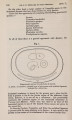
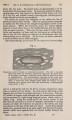
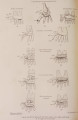
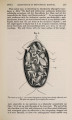
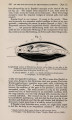
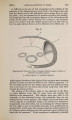
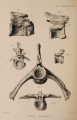
Show 502 PROF. HOWES AND MR. A. M. DAVTES ON THE [Dec. 4, The supernumerary phalanx reaches an altogether special development in this family, and all stages in its histological structure are represented (cf. ante). In II. peronii it attains the maximum bulk observed in the entire Anuran order, the total length of its ventral border (fig. 13) exceeding that of the terminal phalanx. It is very surprising that, iu spite of this, it does not even become hyaline in this species. The remaining joints exhibit minor structural differences, but they are all modifications of a condition fully exemplified in Nototrema (figs. 5, 6). The place of the syndesmodial pad is occupied by a powerful annulus which, although generally dense and fibrous, never becomes converted into hyaline cartilage. Looked at in tangential sections this is seen (fig. 6) to be well defined and in close connection with the synovial capsule; it furnishes articular surfaces for the dorso-lateral portions of the apposed phalanges, and, as seen from this aspect, it bears an astonishing resemblance to the supernumerary phalanx of the same genus (p.s., fig. 7) as viewed in median section. In median longitudinal section it is found to be perforated (fig. 5), mainly for transmission of a strand of elastic tissue (inter-articular ligament, I.), the fibres of which pass, in a somewhat complicated manner, between the ventral borders of the adjacent epiphysial cartilages. When analyzed in detail, this ligament is seen to be largely cellular, and in a conditiou which admits of little doubt that it represents the modified central portion of the original syndesmosis. b. BUFONID-E. Examined:- Pseudophryne bibronii, 23 millim. In the genus above named the syndesmodial pad is met with in the distal joints alone. Structurally it is little modified, but it gives the appearance of being subdivided medially into two strands which are completely confluent ventro-laterally with the adjacent epiphysial cartilages and pass ventrally downwards, converging, for attachment to the investing tunic. None but feeble traces of the pads are met with in the other joints, and these may be either converted into comparatively unimportant ligaments or reduced to an absolutely vestigial condition. Kolliker, in describing the development of the Mammalia, writesl, on the authority of Henke and Reyher (6), " wandeln sich die Gelenkstellen in ihren iiusseren Theilen je liinger urn so deutlicher in Fasergewebe urn, worauf dann in einem gewissen Stadium auch die Gelenkhdhle in Form einer engen Spalte erscheint." Henke and Reyher's " Zwischenscheiben," in which these changes go on, is identical in the main with our syndesmosis; and in view of these facts it becomes exceedingly probable that the splitting above recorded in the Bufonid may represent a persistence, in a slightly modified form, of the initial stage in formation of the typical synovial capsule. 1 Entwicklungsgesch. p. 493. |