| OCR Text |
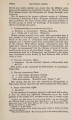
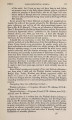
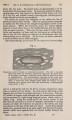
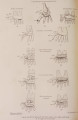
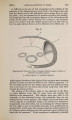
Show 1888.] THE CARPUS AND TARSUS OF THE ANURA. 177 " cuboideum " (2, 3). This compound is interposed between the astragalus and the heads of metatarsals 2 and 3. Naviculare (centrale), n', and hallux-tarsal.-The former articulates obliquely upon the epiphysial cartilage of the astragalus; its outer face bears two convexities of nearly equal size, which are separated by a shallow groove. The ventral convexity furnishes the main articulation for the pre-hallux (see woodcut, fig. C). The hallux-tarsal (I) is generally, though not invariably, present; when recognizable as a distinct element it assumes the form of a small nodule of cartilage, lying buried up in a confused mass of ligamentous tissue, in tbe interspace between the postaxial hinder border of the naviculare, the head of the hallux-metatarsal, and the os cuboideum (cf. p. 147). In the Bull Frog (R. pipiens) this cartilage ossifies, but we have never observed that, to be the case in R. temporaria. Pre-hallux (calcar).-Born admits the existence of from 2 to 4 pieces in this structure (cf. p. 149), while he records (5, p. 233) the presence of three * such in R. arvalis, in contradistinction to Leydig. In young Frogs of 20 millim. in length we find four distinct segments of hyaline cartilage. The first or tarsal segment (ph. i.) articulates with the naviculare ; the second or metatarsal one is the largest, and bears a small retral process ; of the third and fourth or phalangeal segments, the latter undergoes degradation and is represented only in ligament in the adult. The three persistent segments ultimately undergo ossification and usually remain distinct. IV. CONCLUSIONS. Fore Foot. 1. That the pyramidale represents the ulnare, and that there is insufficient evidence upon which to base a final determination of the morphological value of the lunatum. 2. That the naviculare is a preaxial centrale, and that its connection with the radius is always secondary. 3. That a vestigial 5th carpal is present in the adults of the Discoglossidae and Pelobatidce. 4. That that element hitherto regarded as the 5th carpal is a postaxial centrale, and that the living Anura are unique, as an Order, in the invariable possession of two large centralia carpi. Hind Foot. 5. That no traces of a third proximal tarsal element are forthcoming at any stage in development; and that the morphological value of the astragalus and calcaneus has yet to be settled. 6. That while the tarsalia of the 4th and 5th digits are often represented in ligament, skeletal vestiges of the fourth one are forthcoming in the Discoglossidce. 1 Four actually ; but it will be remembered that he regards our centrale (naviculare) as the pre-hallux tarsal. |