| OCR Text |
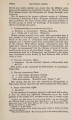
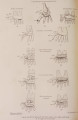
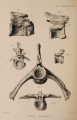
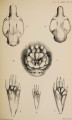
Show 426 MR. J. W. HULKE ON THE SKELETAL [Nov. 20, supposition, since instances of such plan of structure are common. Thus in Fish the spinous processes are built up by the appositio.1 of a pair of flat styles primitively distinct, and this composite process is segmentally separate from the summit of the neural arch to which it is attached by the medium of soft tissue. The Crocodilian atlas is not to be regarded as a degraded vertebra, but as one retaining the plan of construction common in the earliest reptiles and their progenitors. Actinodon needs but the addition of an internal ossification enclosing the axial part of the notochord to furnish a close parallel. Remaining Cervical Vertebrae (Plate XVIII. fig. 2).-All behind the two foremost possess an upper and a lower transverse process, the former borne upon the arch, the latter upon the centrum. The former (diapophysis) is always longer than the lower, and projected outwards and downwards. Its root is in or slightly above the level of the neuro-central suture, and it is nearly equidistant from both ends of the centrum. The parapophyses, shorter and stouter, approach closely the anterior terminal surface of the centrum. In vertebrae closely following the epistropheus, the parapophyses occur at the junction of the lateral with the inferior surface of the centrum, thus augmenting the breadth of this. Between the parapophyses, anteriorly, the ventral surface is depressed, whilst posteriorly, in the same direction (transversely), the surface presents a low keel. Both terminal surfaces of the centrum have a roughly circular outline ; the anterior is nearly plane, and the posterior is distinctly concave. As the trunk is approached the parapophysis ascends on the side of the centrum, and the diapophysis rises on the neural arch. The antero-posterior extent of the sutural attachment of the neurapophysis to the centrum nearly equals that of the latter. The spinous process is compressed, its outline square. The zygapophyses spread considerably, and the articular surfaces of the anterior have an upward slant. Trunk Vertebrae (Plate XVIII. fig. 3).-In the front, of the thoracic region of the vertebral column the parapophysis leaves the centrum, and the capitular costal facet appears on the anterior border of the upper transverse process, just external to the praezygapophysis, as in now living Crocodiles. The trairsverse process is long, it is directed nearly horizontally outwards, and it bears at its free extremity the costal tubercular joint. The figure of the centrum is cylindroid, its middle is constricted. Towards the loins the para-pophysial or, as it may be preferably named, the capitular costal articulation moves outwards towards the free end of the transverse process, where it finally coalesces with the tubercular facet, both forming there one single costal articulation. Sacrum (Plate XVIII. fig. 4).-There are two sacral vertebrae. These may be distinguished from all others by their greater massive-ness, also by the stoutness and length of their transverse processes. These latter are composed (1) chiefly of an inferior element which ossifies independently of the centrum (with which it is united by a suture that long continues distinct), and in virtue of this claims to |