| OCR Text |
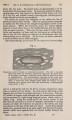
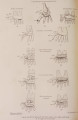
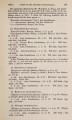
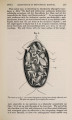
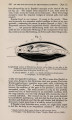
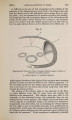
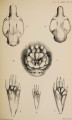
Show 18S8.] THE CARPUS AND TARSUS OF THE ANURA. 175 most 18 to 20 mm. in length, it flanked from one-third to three-fourths of the preaxial border of the lunatum. In these, as in the adult (fig. 2), it is four-cornered as seen from the dorsal aspect; in old Frogs it becomes triangular and it may fuse with the lunatum, in the manner already described (p. 1 72) for Microhyla. The lunatum (I.) articulates proximally with the epiphysial border of the radius, preaxially with the naviculare by a concave or flattened surface, and postaxially with the proximal half of the inner border of the ulnare (pyramidale)-between it and the distal half of this bone the foramen intercarpi is enclosed (cf. p. 156). The ulnare (pyramidale) (p.) is in articulation proximally with the ulna and distally with tbe large capitato-hamatum (3, 4 k) of the distal row; the hinder half of its preaxial border is free, as above stated. The articulations of this element are of a loose order with the exception of that associated with the capitato-hamatum ; this bears antero-ventrally a projecting socket, which is excavated to receive a corresponding and prominent downgrowth of the ulnare. Looked at in situ, with the fore foot in the extended position, the lunatum is most dorsally extended, and the ulnare most ventrally so. Examination of the parts thus shows that, while the rotation of the fore foot upon the radius and ulna has affected the articulation between these bones and the proximal carpals as a series, it has also brought about a less conspicuous rotation of the proximal upon the distal carpal elements. Capitato-hamatum (3 4 k).-It is needless to recapitulate the grounds upon which we have come to regard this as a compound of the 3rd and 4th carpalia of previous workers with our postaxial centrale. Postaxially it sends up a lobe which embraces the free border of the ulnare, much in the manner of the secondary relationship assumed between the naviculare and lunatum. Proximo-inter-nally it articulates with the naviculare, lunatum, and ulnare, distally so with the metacarpals 3, 4, and 5, by special condyles. This compound transmits ventrally, in the adult, the lateral ramus of the ulnar nerve; the foramen through which that passes is, in young animals, represented by an open groove (cf. p. 160). Carpal of 2nd digit.-This element (2) varies considerably in shape, being sometimes rectangular, at others convex on all sides and approximately spherical. Carpal of the pollex^).-This is more fully represented than might be imagined, on a knowledge of the great reduction of the pollex itself. It is strongly convex externally, and concave internally, for articulation upon the carpal of the second digit and the naviculare respectively. Pollex.-This is invariably in a vestigial condition, consisting in the adult (see woodcut, fig. B ) of a single piece, excluding its carpal, with which it is in definite articulation by a facet. Applying arguments previously adduced (p. 149), we regard this structure as representative of the entire first digit, rather than of its metacarpal alone as is more generally and empirically asserted. Metacarpals.-In the male the metacarpal of the second digit 13* |