| OCR Text |
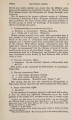
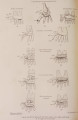
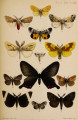
Show 1888.] FROM T H E HIMALAYAS. 391 two thirds between the base of second and end of the cell, third a short distance beyond the cell, fourth and fifth at one third beyond the cell; discocellulars inwardly-oblique, slightly concave, upper longest, radial from near the lower end; middle median at one-sixth and lower at one half before end of the cell; submedian much recurved from the base. Hind wing short; cell extending to less than half length of the wing; two subcostals from end of the cell, the upper curving slightly upward from the end; discocellulars outwardly-oblique, recurved, radial from the middle ; the middle median vein at one eighth and lower at one third before end of the cell; submedian and internal slightly recurved. Body long. Allied to Pergesa. DAHIRA RUBIGINOSA, n. sp. Male. Fore wing dark reddish olivaceous-brown ; crossed by three indistinct outwardly-oblique darker waved lines, three or four discal inwardly-oblique lines, and a curved line from the apex, the latter white-speckled ; a blackish discocellular spot; cilia black, minutely spotted with white : hind wing red, the abdominal area and extreme outer margin brownish ; cilia white. Body dark reddish-brown above, yellow beneath, with dull greyish-white dorsal segmental bands. Wings beneath dull paler red; both wings crossed by indistinct discal darker waved lines ; legs greyish-white above. Expanse 2-f- inches. Hab. Mundi, N.W. Himalaya. In coll. British Museum. " Taken at Mundi (a native state), in March; at sugar." (Hocking). AMPELOPHAGA FASCIOSA, n. sp. Male and Female. Fore wing pinkish olivaceous-brown ; crossed by two outwardly-curved oblique indistinctly darker brown narrow subbasal fasciae, a broader medial fascia, and two slender discal lunular fasciae, beyond which a streak ascends to the apex, the outer border of the wing being much paler ; an indistinct spot at end of the cell: hind wing dusky purplish ochreous-brown, with an indistinctly paler pinkish discal fascia, and cilia. Body darker ochreous olive-brown, pinkish beneath, with an ochraceous-white dorsal line, and a lateral line on thorax. Expanse 3| inches. Hab. Dharmsala. In coll. British Museum. Taken at sugar only, by Mr. Hocking. Specimens taken at Umballa by Capt. R. B. Reed are also in Mr. Moore's collection. HEMARIS SIMILLIMA, n. sp. Nearest allied to H. fuciformis. Fore wing with a vinous-black costal, outer, and posterior marginal band, the outer band somewhat narrower than in H. fuciformis, the posterior band sparsely covered with olive-green scales : hind wing with cupreous-red marginal band, the abdominal border prominently white-speckled. Head, thorax, and base of abdomen pale dull ochraceous olive-brown, the two red |