| OCR Text |
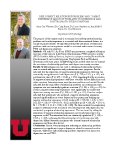
Show CLINICAL TRIAL OF MINDFULNESS-ORIENTED RECOVERY ENHANCEMENT INTERVENTION FOR PRESCRIPTION OPIOID MISUSE Martha L. Mendes (Eric L. Garland, Ph.D., LCSW) College of Social Work Within the past few decades rates of opioid misuse have increased dramatically in the U.S. Some researchers argue that the availability of prescription opioids, together with the misunderstanding and underestimation of the addictive power of opioids, have contributed to the increasing rate of opioid use for non-medical reasons (Ling, Mooney, & Hillhouse, 2011). According to the 2008 National Survey and Drug Use and Health (NSDUH), over 34 million individuals in the U.S., starting from age 12, reported using opioids for non-medical reasons (Reifler et al., 2012). Despite data suggesting risk of opioid misuse when prescribed, opioids remain crucial for many individuals to control chronic pain. A promising treatment for this growing problem is Mindfulness-Oriented Recovery Enhancement (MORE), developed by Dr. Garland. MORE is an integrative treatment for hedonic dysregulation in Substance Use Disorder (SUD), stress, and pain. In order to understand why MORE is a promising intervention for prescription long-term opioid misuse, we need to understand one important principle of SUD. Individuals with SUD show a dysregulated processing of natural rewards. This is a key mechanism subserving the maintenance of drug addiction (Garland et al., 2014). Abusers of alcohol, opiates, and stimulants show impairment on tasks assessing different aspects of executive function (EF), including decision-making and emotional control (Hagen et al., 2016). “Emerging neuropsychopharmacologic models suggest that dysregulated reward processing is a central pathogenic process in the etiology of prescription opioid misuse and addiction among chronic pain patients” (Garland et al., 2014, p. 328). This reward deficit manifests as cravings. If dysregulated processing of natural rewards is one of the principles that maintains dependence on illegal and prescription drugs, then resetting the hedonic set point in the brain so it can process natural reward normally again may be the means of reducing or, better yet, reversing this dysregulation in the brain (Garland et al., 2014). Previous study findings have demonstrated that MORE significantly reduced chronic pain, pain-related impairment, and stress while decreasing craving and opioid misuse. We are currently working on a full scale clinical trial, in our community, to determine if MORE is a hopeful intervention for individuals with chronic pain and prescription opioid misuse. This full scale clinical trial will be completed in approximately 3 to 4 years. |