| OCR Text |
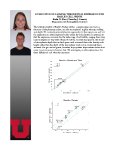
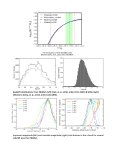
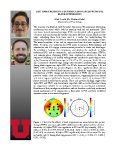
Show THE PRIMUS LUMINOSITY FUNCTION OF GALAXIES Benjamin F. Knowlton (Antonio D. Montero-Dorta) Department of Physics & Astronomy The Luminosity Function of galaxies (LF) is a statistical property of a galaxy population that provides important information about the formation and evolution of galaxies. Our goal is to use the PRIMUS survey to compute the LF at redshift z~0.5, and compare it with other datasets and current models of galaxy evolution. We are currently working on this and are in the phase of understanding the data and generating the necessary plots to analyze the data. The LF of galaxies will provide a distribution of galaxies per luminosity interval, which will allow us to compare galaxy populations at different redshift in a consistent manner. The PRIsm MUlti-object Survey (PRIMUS) is a large faint galaxy spectroscopic redshift survey that was conducted on the Magellan/Baade telescope at the Los Campanas Observatory in Chile. It has around 120,000 robust galaxy redshifts and focuses on regions with deep Spitzer, optical, and Xray data. Some of the goals for this project will be to: understand the advantages of using PRIMUS data and the issues that affect them; develop the programming skills to analyze the data; generate the basic plots that statistically characterize the data at different redshifts: absolute/apparent magnitude plots, color-color diagrams, etc.; characterize incompleteness and selection/systematic effects in PRIMUS; implement the methods for computing the LF, both for the blue and the red galaxy population, in different redshift slices; and compare with BOSS and other surveys at similar redshifts. This research project is still in a preliminary phase. We are currently in the process of developing the computational machinery to analyze the PRIMUS data, using Python/IDL. In particular, we are studying how the distributions of the main observables of the galaxy population (i.e. apparent and absolute magnitudes, color) depend on redshift. Subsequently, we will compute the LF for both the red and the blue galaxy populations using the V_max and the SWML methods. An important aspect of this computation is the characterization of incompleteness, selection effects and photometric errors in the survey. If these issues are not addressed properly, the information that we can extract from the LF will be severely biased. Finally, we will compare our results with other galaxy’s samples and galaxy evolution models. In particular, this work will complement the characterization of the main properties of the red galaxy population at z~0.55 presented in Montero-Dorta et al. (2014). References: Coil, et al., 2010, arXiv:1011.4307 Dawson, et al., 2013, The Astronomical Journal, 145:10 Efstathiou, Ellis, & Peterson, et al., 1988, MNRAS, 232, 431 Johnston, et al., 2011, Astron Astrophys, hhp://arxiv.org/abs/1106.2039v3 Montero-Dorta, et al., 2014, arXiv:1410.5854 Schmidt 1968, Astrophys. J., 151, 393 |