| OCR Text |
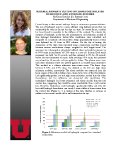
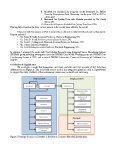
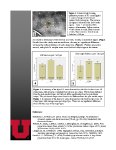
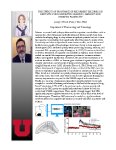
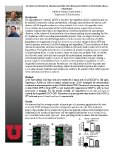
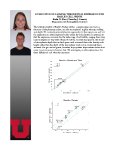
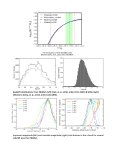
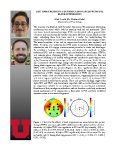
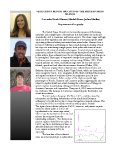
Show EXTRACTING WAVELENGTH DATA FROM A MODIFIED POINT SPREAD FUNCTION: A COLLECTION OF MONTE CARLO SIMULATIONS Timothy J. Allen (Jordan Gerton, PhD) Department of Physics and Astronomy We introduce a new method for extracting wavelength data from an imaged molecule. This cheaper, faster, and more effective process takes advantage of the fact that point sources which emit different wavelengths produce different point spread functions on a camera. A series of simulations shows that such an optical system is indeed plausible. The simulations consist of two parts: one with sources that emit a single wavelength and another with sources that emit a spectrum of wavelengths. Our results showed that for a single wavelength emitter, the wavelength could be determined within 5 nanometers up to 95% of the time. They also showed that magnification of the microscope does not have a large impact on the ability to determine the wavelength. However, we did find that some wavelengths are easier to identify that others. For instance, in our setup, wavelengths of 450 nanometers were relatively easy to identify when compared to wavelengths of 580 nanometers. The simulations on the spectrum sources yielded similar results. The outcome of these experiments were so promising that we have applied for a patent on the specific method that we use to generate these modified point spread functions. We hope that this new method can replace the bulky, expensive, and inefficient methods commonly used in today’s laboratories. Below is shown some of the shapes that are created using our technique. They are 690 nm, 610 nm, 430 nm, and 485 nm starting from the top left and moving clockwise. |