| OCR Text |
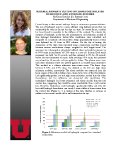
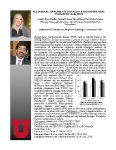
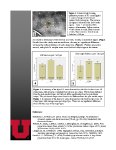
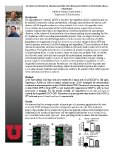
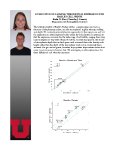
Show MATERIAL PROPERTY TESTING OF CARBOXYMETHYLATED HYALURONIC ACID HYDROGEL POLYMER McKenna Drysdale (Dr. Brittany Coats) Department of Mechanical Engineering Corneal injury is often treated with eye drops or ointment to prevent infection. The use of hydrogels may be a more efficient drug delivery system that can comfortably be worn in the eye for days at a time. In contact lenses, comfort has been found to correlate to the stiffness of the material. To estimate the comfort of hydrogels in the eye, the instantaneous and relaxation moduli of four hydrogel formulations before/after sterilization were calculated and compared to a standard soft contact lens. Strips approximately 6mm x 10mm were hydrated for 24 hours in PBS solution. On the day of testing, the dimensions of the strips were measured using a microscope and then placed between custom screw-driven clamps designed to hold fragile tissue. The specimen was submerged in phosphate buffered saline and pulled in tension up to 9.0% strain in increments of 0.5% strain at a rate of 1 in/min. Each strain increment was held for 30 seconds and then returned to 0% for 60 seconds before the next increment of strain. After reaching 9.0% strain, the specimen was relaxed for 60 seconds and then pulled to failure. The plateau stress from each stress relaxation curve was plotted against its associated strain increment. This resulted in a bilinear relaxation stress-strain curve. The linear slope between 0-4.5% and 5-9% strain was defined as the low and high strain relaxation modulus, respectively. The elastic modulus was extracted from the linear region of the pull-to-failure stress-strain curve. One of the formulations had significantly greater low and high strain relaxation moduli than the other formulations, but this difference was eliminated after sterilization. The unsterilized hydrogels had lower relaxation and elastic moduli than the soft contact lens, suggesting they would be more comfortable than a soft contact lens. However, sterilization made hydrogels significantly stiffer, and even the least stiff hydrogel formulation was nearly 3 times stiffer at lower strains than the contact lens (Figure 1). It is unclear at this time whether an increase in stiffness at low strains would still be well-tolerated in the eye. Figure 1. Relaxation moduli of hydrogels compared to a standard contact lens. |