| OCR Text |
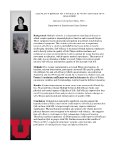
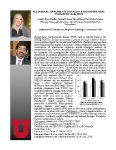
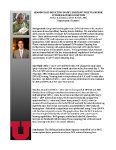
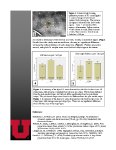
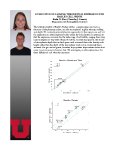
Show BIODIVERSITY ALONG THE WILDLAND-URBAN INTERFACE OF RED BUTTE CREEK Hailey Blair (Cagan H. Sekercioglu) Department of Biology Red Butte Creek is an ideal place to study the effects of urbanization on biodiversity; Red Butte Canyon is uniquely protected from human activity because the canyon was used as watershed for Fort Douglas army post, then in 1969 when the U.S. Army no longer needed the lands, the U.S. Forest Service designated Red Butte Canyon as a Research Natural Area (RNA). Below the protected canyon, the creek flows through the urban areas around the University of Utah campus on its way to Liberty Park and eventually to the Jordan River. In our study comparing urban and wildland areas of a wildland-urban interface (WUI), the RNA of Red Butte Canyon represents the “control” site devoid of human activity, while Red Butte Creek through the University of Utah campus represents the “treatment” site impacted by human activity and development. Our research along the WUI of Red Butte Creek has been conducted from 2014 to the present. This research is investigating the biodiversity and species richness of medium to large mammals along the riparian area and how it differs between the RNA and the urban area of the WUI. By installing several camera traps in each area, this study has been able to record the different species living along the creek as well as where along the wildland-urban interface each of these species can be found. We have captured photos of many species, including mule deer, elk, moose, raccoon, bobcat, cougar, striped skunk, North American porcupine, American black bear, coyote, domestic dog, domestic cat, and human. Results have shown that many predatory mammals in Red Butte Canyon such as cougar, bobcat, and American black bear are unable to tolerate the disturbances to the habitat in the urban area; the resulting trophic cascade has caused increasingly large populations of mule deer, raccoon, and other prey species in the urban area. Additionally, large ungulates such as moose and elk are also unable to tolerate the disturbances in the urban area; as a result, mule deer experience less interspecific competition for resources in the urban area, which promotes population growth. This study will be continued to determine how these shifts in the population dynamics of the ecosystem as a result of urbanization will affect the long-term biodiversity in Red Butte Canyon. This work was supported by funding from the Undergraduate Research Opportunities Program at the University of Utah awarded to Hailey Blair. |