| OCR Text |
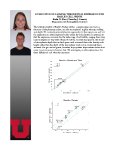
Show MUSICAL EVIDENCE FOR SYLLABIFICATION OF HIGHLY MORAIC STRUCTURES IN ENGLISH Joselyn Rodriguez, Jenica Jessen, Sara Ng (Abby Kaplan) Department of Linguistics Several studies have shown a connection between stressed syllables in language and strong metrical positions in music while acting on the inference of a direct correlation between musical notes and syllables (1,4). Another study looked at linguistic behavior of Mandarin Chinese by using music as a medium by having subjects learn a tune and then having them put words to the music (3). These and other studies provided a foundation for our research methodology. This project was interested in the syllabification of rimes ending in the diphthong [ai] and [ai] followed by a liquid (either [ɹ] or [l], e.g. “fire”, “tile”, etc). Native speakers of English are quite adept at determining syllabification patterns in English; interestingly, when speakers are asked to syllabify words ending in these target rimes ([aiɹ] or [ail]) there some who respond that it clearly has two syllables or that it clearly only has one while some are uncertain. For this project, we wanted to look at the distribution of native English speakers who determine the target rimes as one or two syllables. However, rather than asking speakers for explicit judgements, we looked at syllabification patterns through a musical medium in order to indirectly study American singer-songwriters’ implicit syllabification of these rimes. We looked at the number of musical pitches sung to different rimes -- [aiɹ] and [ail] -- as well as several control rimes for comparison -- [ain], [aim], [al], [aɹ], [il], and [iɹ] -- with the hypothesis that the number of pitches would be directly correlated to the number of syllables. We gathered the discographies from 12 different American singer-songwriters (born in USA, native English, must write and sing own music), and compiled all the target and control rimes into a spreadsheet and coded the number of pitches sung to each. Each token was coded by two different researchers to ensure consistency. The results from the experiment show a clear difference between artists who sing [aiɹ] - words with two pitches versus artists who only sing it with one. Therefore, the conclusion that can be drawn from this study is that there are indeed two groups of people - those who syllabify [aiɹ] words as two syllables and those who syllabify it as one. We also conclude that music is a reliable method to study phonological behavior such as this. However, we are left with several questions that could not be addressed within the scope of this study such as the behavior of polymorphemic words such as “higher”, “liar”, etc, or the effect of orthographic input in syllable perception, the acoustic difference between two and one syllable [aiɹ], and finally the effect of age, place of birth, and gender on an artists’ realization of the target as one or two syllables. |