| OCR Text |
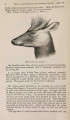
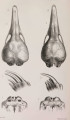
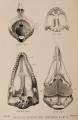
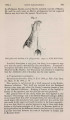
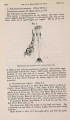
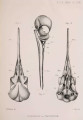
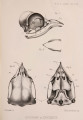
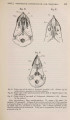
Show 1885.] GENUS PARADOXURUS. 799 p. 66) as ash-coloured (one pale ash, the other flavescenti-cinereus), with three dark dorsal bands and spots on the sides ; and it is not clear what the supposed specific distinctions were. The type is in the British Museum, and presents no peculiarity. P. pallasii was founded on a skin now in the British Museum, and showing the whitish frontal band distinctly, but in other characters approximating to P. niger, there being no stripes on the back, where the fur has long black tips. There is no skull, so the characters of the teeth cannot be examined. The figure in Gray and Hardwicke's Illustrations, if taken from this specimen, is very incorrectly coloured, the markings being much exaggerated. The circumstance that Gray (P.Z.S. 1861, p. 136) identified two Cambodian skins with P. pallasii is in favour of the name being considered a synonym of P. hermaphroditus. The type of P. crossii was a specimen kept in confinement; the characters of the fur are consequently hot to be depended upon; the upper sectorial tooth in the skull figured1 is broader than it usually is even in P. hermaphroditus, aud quite unlike that of P. niger. P.finlaysonii was founded on "a rough sketch brought by Mr. Finlayson from Siam "! From the description the animal represented was probably a typical example of P. hermaphroditus. "P. quinquelineatus and P. musangoides, Gray, are perhaps only varieties of the young animal of this species (P. fascialus'•-= musanga)." 2 Except that I should substitute a stronger term than "perhaps," I have for once the satisfaction of concurring in Dr. Gray's opinion. Nothing is known of the types of these supposed species. Of P. nubia I hope to obtain further information. There is nothing in the figure or description to show that the animal differs from P. hermaphroditus; but the locality was given as Nubia apparently on trustworthy evidence, the animal having been brought alive to Paris by a Mr. Burton of Bordeaux. Wagner's name P. felinus was, as already remarked, merely substituted for hermaphroditus. Of Gray's Paradoxurus nigrifrons, the description of which only appeared in 1864, its author admits that the skull is very much like that of P. crossii3, and on the next page that " the nature and colour of the fur " are very similar in both ; but P. nigrifrons <l is rather darker in every part, and the crown and cheeks are reddish black, being in P. crossii grey or whitish." Both specimens, it should be remembered, had been kept in confinement. Hombron and Jacquinot described P. setosus from a young specimen obtained at the island of Ceram. The skull is figured, and shows the milk-teeth. There is nothing in the description or figure to justify the separation of the form. The type of P. strictus, Hodgson, is a skin with short fur; the dorsal stripes and rows of spots are unusually distinct and numerous. 1 P. Z. S. 1864, p. 535. 2 P. Z. S. 1864, p. 537. 3 P. Z. S, 1864, p. 534. 52* |