| OCR Text |
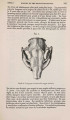
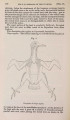
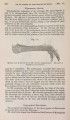
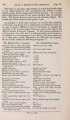
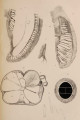
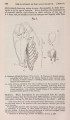
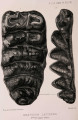
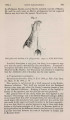
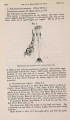
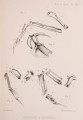
Show 1885.] DR. ST. G. MIVART ON THE ARCTOIDEA. 367 Taxidea1.-The American Badger, or Carcajou, is an indefatigable burrower. It eats Spermophiles, Arvicolas, birds' eggs, and snails, also honeycomb, wax, and bees. The bones and wool of lambs have been found in its burrow. In the north it hibernates from November to April, but does not lose much flesh. It has three or four young at a birth. It is so strong an animal that two men have been unable to pull it out of its burrow by its hind legs. For further details as to its habits, see Coues, ' Fur-bearing Mammals,' p. 285, and also Audubon and Bachman, vol. i. p. 363. It is remarkable for the enormous claws of its fore paws. The muzzle is furry except at its extremity, which is naked, inclined downwards and backwards, with a median, vertical groove. The nostrils are not visible laterally. The eye is small and high up. The ears are low, rounded, and very broad, with an exceptionally large external aperture protected by long hairs. The palmar and plantar surfaces bear naked pads. It varies much in colour. The short tail has beneath it a subcaudal pouch (as in Meles), with a bilobed prominence in front of it. A good account of the habits of the animal will be found in Coues's ' Fur-bearing Mammals,' p. 280. It ranges through western and central North America from N. lat. 58° into Mexico. There are 15 dorsal, 5 lumbar, 3 sacral, and 14 or more caudal vertebrae. The ultimate phalanges of the digits of the manus are very much longer relatively than those of any other Carnivore, those even of Suricata being but little more than half the relative length of those of Taxidea. The pelvic limb is but of the same length as the pectoral limb, a condition which only obtains besides in Mydaus amongst Carnivores. Only in Crocuta is the pectoral limb the longer. Hence, for the first time in our examination of Arctoids, we find the scapula with the postero-superior angle sharply produced. The metacarpals are still shorter relatively than in Meles. There are very large hyperapophyses on the laminae of the cervical vertebrae. In addition to the cranial characters described by Prof. Flower2, we may note that the mastoid and paroccipital processes are much less prominent than in the form last described, the mastoid not descending below the inferior margin of the meatus auditorius externus3. The palate is a little less prolonged behind the last molars than in Meles, and much less so than in Arctonyx. The postglenoid 1 See Baird, Mam. of N. A. 1857, pp. 202, 745, pi. 39. fig. 2; Gray, P. Z. S. 1865, p. 141; Stev. IT. S. Geol. Survey Terr. 1870, 1871, p. 461; Allen, Pr. Boston S. Nat. H. xiii. 1870, p. 183, and Bull. U. S. Geol. and Geogr. Surv. Terr. vol. ii. no. 4, 1875, p. 330 ; Waterhouse, P.Z. S. 1838, p. 154, and Trans. Z. S. 1841, p. 343, pi. lix.; Buffon, Hist. Nat. Suppl. iii. p. 242, pi. 49 ; Coues, Fur-bearing Mammals, 1877, p. 261; Wagner's Supp. n. p. 182; F. Cuv. Mamm. iii. p. 45; Gervais, Mamm. ii. p. 103; Gmelin, Syst. Nat. i. (1788) p 102 n 7- Shaw, Gen. Zool. i. 1800; Fischer, Syn. 1829, p. 151 ; Lesson, Mam. 1827,' p. 141. no. 372; Richardson, F. B. A. i. p. 37. no. 12, pi. ii.; Audubon and Bachman, Q. N. A. i. p. 360, pi. 47. 2 P. Z. S. 1869, p. 11. 3 It does not so descend in Ailurus and Bassaris. |