| OCR Text |
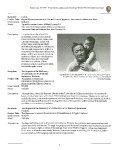
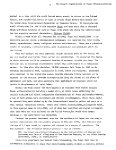
Show NPS Fonn 10-900 USDIINPS NRHP Registration Fonn (Rev. 8-(6) OMB No . 1024-0018 CENTRAL UTAH RELOCATION CENTER SITE (TOPAZ) United States Department of the Interior, National Park Service Page 48 National Register of Historic Places Registration Form Although incidents of violence were few at Topaz, an attack on Chiura Obata clearly reflected the philosophical divisions among evacuees, One evening in April 1943, while returning to his barracks from the showers, the artist was hit in the face by an assailant causing serious injury. Apparently, a rumor had spread that Obata, who was regarded as being cooperative with the administration and who had answered "yes, yes" on the loyalty questionnaire, was associated with the FBI. After spending nineteen days in the Topaz Hospital and further time receiving medical treatment in Salt Lake City, Obata and his family were granted permanent leave to ensure their safety. 144 Rev. Taro Goto had also been threatened leaving the showers and was given permission to exit camp. Project Director Ernst promised to remove any person from Topaz who threatened or committed an act of violence, and a few were subsequently sentenced for assaults. 145 Persons believed to be disloyal or unsympathetic to the cause of the United States (including those who answered "No-No" to the loyalty questions) or those labeled dissidents, along with their families, were segregated from the general population. Tule Lake, the most self-sustaining relocation camp and the one with the most persons of allegedly questionable loyalty, became the segregation center for these evacuees. Nearly 1,500 Topaz residents were transferred to Tule Lake, and a similar number of persons from Tule Lake considered "loyal" were sent to Topaz. Eleven people who statedin their questionnaires that they were not loyal to the U.S ., wanted repatriation to Japan, and would commit sabotage if given theopg0rtunity, were sent to Leupp Retention Center, Arizona. Thirty-six persons were allowed to leave for Japan, 1 6 Sandra C. Taylor analyzed the attitude of the population at Topaz: The Topaz manner of resistance was rarely violent, as its history was to show, but it did include opposition to what was perceived as unwarranted authority. The community forged by the Japanese Americans at Topaz was a peculiar blend of self-government and individual initiative coupled with submission to a Caucasian authority that was, if ultimately absolute, rarely dictatorial or coercive. The morale was never high and it declined with time, but most never . to totaI apathy. 147 gave III Death of James Wakasa One of the events which incited the greatest fear and protest at Topaz was the killing of an elderly resident by a guard on April 11, 1943, just before sunset. James Hatsuki Wakasa, a 63-year-old bachelor from San Francisco, was a college graduate born in Japan and a resident of the United States for forty years. Following postgraduate work at the University of Wisconsin, Wakasa was employed as a chef. He served as a civilian cooking instructor at Camp Dodge, Iowa, during World War I, thereby earning American citizenship. Although initially the administration stated that Wakasa had been shot while trying to crawl through the west fence and had ignored repeated warnings to stop (a report authorities included in the Topaz Times), they later conceded that he had been one to two yards away from the fence. 148 Evacuees offered different versions of the events. Haruko Obata believed that Wakasa approached the fence chasing after a dog. 149 She stated, "The guard in the watchtower shouted a warning to him, but the old man 144 In 1945 Obata was reappointed to the faculty at the University of California. The Oakland Tribune judged that Obata "fought for American principles while at the Central Utah relocation center in Topaz and was physically attacked by anti-democratic elem ents." 14 5 Topaz Times, June 19, 1943, I and August 31, 1945, 4; Hill, Topaz Moon , 91-95 ; Goto, "Missionary Mason;" Charles F. Ernst, Proj ect Director, "Letter to All Residents of Topaz," June II , 1943, reprinted in Topaz Times , June 13 , 1943; Topaz Times. 146 Taylor, Jewel o/the Desert, 153. 147 Ibid. , 105. 148 Millard County Chronicle, April 15, 1943; Taylor, Jewel o/the Desert, 137; Topaz Times , April 12, 1943, I. 149 The WRA report regarding the shooting noted that Wakasa was known to walk his dog in the area. |