| OCR Text |
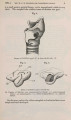
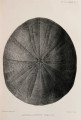
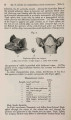
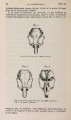
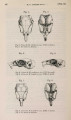
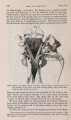
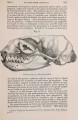
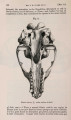
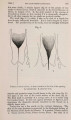
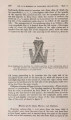
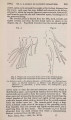
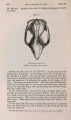
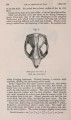
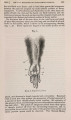
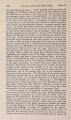
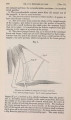
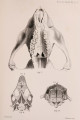
Show 1884.] MR. J. B. SUTTON ON THE CRANIAL ARCADE. 5G7 basi-spbenoid, and ethmoidal cartilage; it extends the whole length of the ethmo-vomerine cartilage, and at its anterior end rests upon a median-placed bone carrying teeth, and usually marked " vomer." The vomer of a human foetus at the time of birth is represented in Plate LIII. fig. 3. It arises from a single ossific nucleus which is deposited in the perichondrium covering the lower border of the ethmo-vomerine plate. It underlies the basi-sphenoidal and ethmoidal regions, and lodges the ethmo-vomerine cartilage in a shallow trough ; anteriorly it ends by resting on two horizontal plates of bone, which in the usual condition of the parts constitute elements of the complex superior maxillary bone. The vomer is represented in situ, Plate LIII. fig. 4, and the parasphenoid in fig. 1, where it will be observed that, so far as shape, situation, and relations go, the two bones correspond in a remarkable manner. If, instead of taking a human foetus at birth, we examine one at an earlier stage, before the hard palate is completed, we shall find that the mouth and nasal fossae form one common cavity, the vomer forms a partial covering to the ethmo-vomerine plate, and rests anteriorly on the premaxillae. In this condition it still more strikingly compares with the Pike's parasphenoid. Indeed, its homology is self-evident. On the other hand, to make the Pike's parasphenoid compare with the vomer of a mammal at birth, it is only necessary to widen the bones forming the anterior part of the palato-quadrate arch so as to meet the parasphenoid, or, coalescing in the median line, shut it off from the buccal cavity. To my mind the most important feature that surrounds the parasphenoid (vomer) seems to be this :- In crania possessing no bony basi-occipital or ossified sphenoidal region in the base of the skull, this bone plays the part of a keel to the brain-case and face (in Menobranchus it constitutes the floor of the cranium), and forms an important element in the structure of the skull. As ossific nuclei begin to be deposited in the basal cartilage, such bones as the basi-occipital and the basi- and pre-sphenoid are support enough in themselves ; thus the function of the parasphenoid (vomer) becomes abrogated and commences to lose its relatively great importance. Take for examples Menobranchus, Siredon, and Siren, all of which lack a basi-occipital bone ; in each of these instances the parasphenoid (vomer) extends as far backwards as the anterior boundary of the foramen magnum. _ In the Pike, Cod, and such fish possessing an ossified basi-occipital, the vomer only ventures as far backwards as the anterior end of that bone, merely for greater support. Ascending the scale of vertebrates and gaining mammals, we find well-ossified bones in the skull's base, of cartilage origin, strong and capable supports for the skull-vault; and the vomer is reduced to slender and delicate proportions, merely performing the insignificant duty of forming a part of the septum between the neighbouring nasal passages. In the skull of the Frog, however, this median parasphenoid |