| OCR Text |
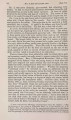
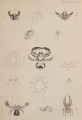
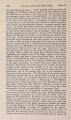
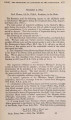
Show 1884.] SPECIES OF OREASTER. 75 four, well developed. All the ventral spines on the disk with one or two spinous tubercles; owing to the narrowness of the arm only one row extends along the side of the adambulacral spines, and the plates at the distal end of this are without spines. The pore-areas of the dorsal side are distinctly marked, but vary considerably in size and form ; the apical region has no central spine, and the most prominent spine of the row along the lophial line is not at all high ; none of the spines along the lophial line are especially prominent, and they are not always separated from one another by equal distances ; at the distal end of the arm they may become rounded tubercles. Madreporic tubercle moderate, just outside the apical region, lozenge-shaped. Colour (in alcohol) creamy yellow. R=148, 220. r=32, 53*5. Breadth of arm at base 32, 50. Hab. Billiton. OREASTER LUETKENI, sp. nov. A diplacanthid form, with the appearance, were it not for the shallowness of its disk, of 0. reticulatus. Supero- and inferomarginal spines; the ventral plates without spines, but most abundantly provided with pedicellariae. R=2*4 r. Disk not elevated : arms, where distinct from the disk, rapidly tapering; most of the supero- and of the inferomarginal plates provided with spines ; of the lophial series the apicai spines are alone well developed ; short, but quite distinct spines developed at all tbe angles of tbe poriferous areae. There are about 21 plates in either series along the side of the arm, but the whole of the side of the arm is occupied by the superior set. The disposition of the spines on these plates is exceedingly irregular : only about half of the plates are spiniferous ; spines on the inferomarginals are rarer and much less developed. In both series plates without spines will be found to carry, perhaps as many as three, pedicellariae. Ot the adambulacral spines the inner row has 8 for each plate ; these are not very delicate, nor are they exceedingly different in length ; between each set is an elongated forcipiform pedicellaria. The outer row has, as a rule, two pretty stout spines on each plate. The ventral plates are remarkably distinct from one another, the granules often larger, the valvular pedicellariae of some size, numerous, especially in the neighbourhood of the ambulacra. The ventral plates which extend along the lower side of the arm often intervene between the inner edges of the inferomarginal plates. The whole of the dorsal surface is rough with spines; the pore-areas are, on the back, very distinct, and generally triangular ; they are specially large along the sides of the arms, the pores large ; the granulation is rather coarse and the granules reach very nearly to the tip of the spines aud spinous tubercles. Madreporic plate large, irregular in shape. Measurements:-R = 117; r=48 ; greatest breadth of arm 3*5. Colour, brownish (in alcohol). Hab. Billiton. |