| OCR Text |
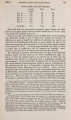
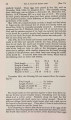
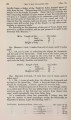
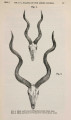
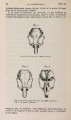
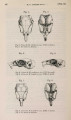
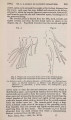
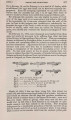
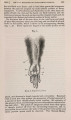
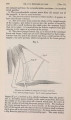
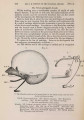
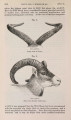
Show 540 MR. P. L. SCLATER ON [NOV. 18, form of the horns is much the same in both specimens. The chief differences are in the slightly greater size and greater length of the horns in Mr. James's specimen, and especially in the more decided twist forward at their anterior extremities. On the whole, however, I think it better to conclude that they belong to the same species until the contrary is shown. The external form of Gazella walleri (assuming this view to be correct) may be shortly described as follows :-Horns lyrate, strongly ringed, running backward almost in a line with the face, and bent forward at the tips. Length, following the curve along the upper surface, 14 inches; in a straight line from base to tip, 11 inches; distance between the point at the tips 3 inches; extreme width 7\ inches ; circumference of horn near the base 5 inches. Colour. Nose, front of face, top of head, neck above and on each side, and brown dorsal band (6 to 7 inches in width) extending all down the back dark brown, almost chestnut. Flanks, separated by a well-marked margin from the dorsal colour, pale brown ; sides of face round the eyes, chin , and line below the throat, and body beneath white. Length of skin, from nape to the base of the tail, about 48 inches. Hab. Somali-land, vicinity of Berberah. I may remark that of two pairs of horns in the British Museum received from Sir John Kirk and determined as Gazella walleri, one pair nearly resemble the typical specimen and the other Mr. James's head. 4. GAZELLA SPEKII, Blyth, Cat. Mamm. Mus. As. Soc. p. 172 (1863). The skin of a small species, probably the same as that to which Mr. Blyth gave this name from Speke's specimens obtained at Berberah \ 5. EQUTJS ASINUS SOMALICUS, sp. (aut subsp.) nov. (Plate L. fig. 1.) Of the Wild Ass of Somali-land Mr. Hagenbeck has not only furnished us with the flat skin which I now exhibit, but has also sent us on deposit a fine living male specimen, which was received on the 11th of August last, and is now in excellent condition. W e have also, fortunately, living in the Gardens a specimen of another African Wild Ass, from the Nubian Desert, purchased in May 1881 ; so that it is easy to institute a comparison between the two, and to assure ourselves that they belong apparently to distinct species or subspecies. As will be seen by Mr. Smit's drawings which I now exhibit, the Somali Ass (PI. L. fig. 1) differs from that of the Nubian Desert (PI. L. fig. 2) in its generally paler and more greyish colour, in the entire absence of the cross-stripe over the shoulders, in the very slight indication of the dorsal line, and in the numerous black mark- 1 Cf. Blanford, Geol. & Zool. Abyss, p. 361. |