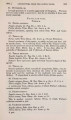
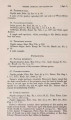
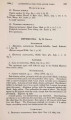
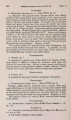
| OCR Text |
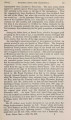
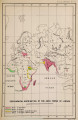
Show 338 MR. F. E. BEDDARD ON THE ISOPODA COLLECTED [May 20, Crozets, and Kerguelen), the shores of New Zealand (?) and some oi the adjacent islands, and the southern and eastern coasts of Australia. The different species have a more or less restricted area of distribution. Seven species (Serolis paradoxa, Serolis schythei, Serolis gaudichaudii, Serolis plana, Serolis convexa, Serolis serrei, Serolis trilobitoides) are found in Patagonia and the Falkland Islands. Of two of these Patagonian species, Serolis schythei and Serolis paradoxa, there are specimens in the British Museum labelled " N e w Zealand," but I believe that this locality is not authenticated beyond a doubt. Three species, Serolis cornuta, Serolis septemcarinata, and Serolis latifrons, are found at Kerguelen. Of these Serolis latifrons has also been obtained at Possession Island, and at the Auckland Islands south of N e w Zealand ; Serolis cornuta is a very close ally of Serolis trilobitoides, if not identical with it; S. septemcarinata is common to all three groups-Kerguelen, the Crozets, and Marion and Prince Edward's Islands. The six species that occur on the shores of Australia are, as has already been pointed out, distinguished by certain characters which unite them together and differentiate them from the other species of the genus. These facts agree with what is known about the distribution of many other shallow-water animals. As a rule, there appears to be a close resemblance between the faunas of N e w Zealand, Kerguelen, and S. America, while the Australian species do not present such resemblances to the New-Zealand species as might perhaps be expected from the close proximity of the two regions. The deep-sea species of Serolis have a wider range than the shallow-water species, although none have as yet been obtained north of the equator. Serolis antarctica ranges from off Pernambuco to the neighbourhood of the Crozets. T w o other species, Serolis gracilis and Serolis neara, were obtained in deep water off the coast of S. America, the former at Station 120 just below the equator, and the latter at Stations 318 and 320 further south, off Buenos Ayres. Serolis bromleyana was dredged at Station 156, close to the Antarctic ice-barrier, and again considerably to the north off the coast of N ew Zealand and between N e w Zealand and Australia. The comparatively wide distribution of Serolis bromleyana and S. antarctica is interesting, and agrees with what is known respecting the geographical distribution of other deep-sea animals. The greatest depth which this genus is known to inhabit is 2040 fathoms; a single specimen of Serolis neara was dredged from this depth at Station 318. Serolis bromleyana was dredged in 1975 fathoms at Station 186, and in 1100, 700, and 410 fathoms in the neighbourhood of N e w Zealand ; Serolis antarctica ranges from 400 to 1600 fathoms. Serolis gracilis was only dredged at one locality, and from 675 fathoms. Gerstaecker, in his account of the Isopoda in Bronn's ' Thierreich,' points out that many species which have a wide distribution are found in deeper water as they pass southwards from the equator to the pole, and instances (from v. Willemoes Suhm's Preliminary Report on the Crustacea, etc., Proc. Roy. Soc, 1874) Serolis bromleyana and another species which I have named Serolis |