| OCR Text |
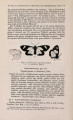
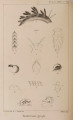
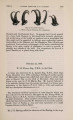
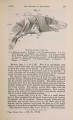
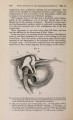
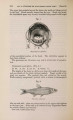
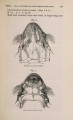
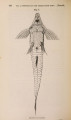
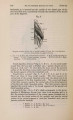
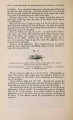
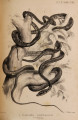
Show 1869.] MR. SCLATER ON A NEW MEXICAN WREN. 591 A short crest on back part of head. Gular pouch extending in a direct line from the lower mandible for about 3 inches upon the throat. Around the eye a bare space separated from the bill by a narrow line of white feathers. Scapulars, lower portion of greater wing-coverts, primaries, and secondaries, some feathers of the upper tail-coverts, and tail jet-black. Rest of plumage white, with a yellowish tint upon the breast. Gular pouch white, as are also the mandibles, the latter having a bluish tinge darkest at the tip, the cutting edges yellow; nail of mandible greenish yellow. Irides dark brown ; orbits pale sulphur-yellow, bounded by a narrow ring of pale bluish grey. Total length about 5 feet; upper mandible 18 inches in length along the culmen, its greatest width l-| inch ; wing 25 inches ; tail 10 inches; tarsus 5 inches; middle toe, without nail, 4f inches; outer toe 4| inches, inner 3 inches, hind toe 1^ inch. Hab. Australia, Van Diemeu's Land. This fine species is an inhabitant of Van Diemen's Land and the continent of Australia, in which countries it is very abundant. So numerous, indeed, is it on the inland waters, that Capt. Sturt states, as related by Mr. Gould, " that a channel of a river from 70 to 80 yards broad was literally covered with Pelicans, and that they were in such numbers upon the Darling as to be quite dazzling to the eye." The Australian Pelican cannot easily be confounded with any other species, its black wing-coverts and tail serving to distinguish it from its fellows. The nest, according to Mr. Gould, is " a large structure of sticks and grassy herbage, placed just above high-water mark ; the eggs are generally two in number, of a dirty yellowish white, 3| inches long by 2f inches broad." This species appears to be generally distributed throughout Australia, although it is gradually retiring before the advances of civilization. 8. Description of a new Species of Mexican Wren. By P. L. S C L A T E R , M.A., Ph.D., F.R.S., Secretary to the Society. (Plate XLV.) When looking through the fine series of American birds in the Royal Zoological Museum of Berlin last summer, I found an example of a species of Wren from Mexico, which was quite new to me, and which, although long since provided with a M S . name, appeared to be undescribed. Dr. Peters, with his wonted liberality, upon m y pointing this out to him, immediately offered me the loan of the specimen for examination and description, if new; and as, after carefully comparing it with other species known to me, I find m y anticipations verified, I propose to characterize the species under the specific name already bestowed upon it in the Berlin Museum. |