| OCR Text |
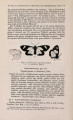
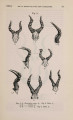
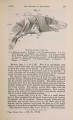
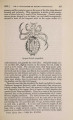
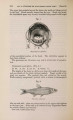
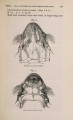
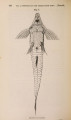
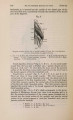
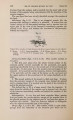
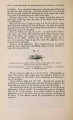
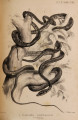
Show 368 ON THE G E N U S M I C R A S T U R . [May 27, but we have hitherto wrongly referred it to its southern representative M. gilvicollis, in which other authors have followed us. In its plumage above, this present bird very much resembles that species; but beneath the narrow grey bands are closer together, and are continued regularly over the thighs, belly, and crissum, whereas in M. gilvicollis they gradually disappear, leaving these parts nearly white. In the adult of M. guerilla also there appear to be three distinct white tail-bands besides the narrow terminal band ; in the adult M. concentricus the normal number seems to be one, or sometimes two. Cassin founded his Micrastur guerilla upon immature specimens obtained by Mr. Pease near Jalapa in Mexico, and has figured the bird in this plumage. As already stated, we have seen other examples in the numerous collections recently made in the same district. In Guatemala Salvin found it common in all the lowlands of the Atlantic slope. From Veragua Arce has transmitted individuals both in the adult and immature plumages. W e have not yet seen it from Panama; but it certainly extends as far south as Western Ecuador, where Mr. Fraser obtained an adult specimen in 1859. This bird is now in the collection of Salvin and Godman. 7. MICRASTUR GILVICOLLS. Sparvius gilvicollis, Vieill. N. D. x. p. 323, et Enc. Meth. p. 1264 ; Puch. Rev. Zool. 1850, p. 91. Micrastur gilvicollis, jr., Pelz. Orn. Novara, p. 10, et Orn. Bras. p. 7; Scl. et Salv P. Z. S. 1867, p. 590. Nisus concentricus, Less. Tr. d'Orn. p. 60 ; D'Orb.Voy. Ois. p. 88. Climacocercus concentricus, Cab. in Tsch. F. P. pp. 18, 98, et in Schomb. Guian. iii. p. 735 ; Burm. Syst. Ueb. ii. p. 87. Hab. Cayenne (Less.) ; Eastern Peru (Tsch.) ; Bolivia (D'Orb.) ; Rio Negro, Barra and Para (Natt.). Vieillot's Sparvius gilvicollis was founded upon a specimen in the Paris Museum, which Pucheran, in one of his articles upon Vieillot's types, declares to be the same as 31. concentricus. Now, although Falco concentricus is an old M S . name of Uliger's, it was first published by Lesson, and based upon a specimen brought by Poiteau from Cayenne, likewise in the Paris Museum. It follows that M. Pucheran, having had the two types before him, had an excellent opportunity of arriving at the result which he came to. Our worthy friend Herr von Pelzeln, of Vienna, has, however, recently come to a different conclusion, and, in his treatise on the birds of the Novara Expedition, has treated M. gilvicollis and M. concentricus as different species. This caused us no small perplexity, uutil, with his usual kindness, Herr v. Pelzeln transmitted to us for examination the whole series of specimens of these two supposed species upon which he had founded his remarks. W e trust that our good friend will pardon us, if, in the interests of science, we state that, after inspection of the specimens and comparison of them with others now before us, we have arrived at a somewhat different conclusion. It is certain that the bird from Mato Grosso, which Herr v. Pelzeln regards as the adult of his M. gilvicollis, is distinct from his M. con- |