| OCR Text |
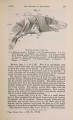
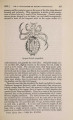
Show 1869.] CLASSIFICATION OF THE CARNIVORA. 31 and established its true position among the Viverridce, the same method of observation has resulted in affording a full compensation to the former group by assigning to it the interesting little A^merican Carnivore the Bassaris, frequently placed among the Viverridce. When this animal was first subjected to scientific examination, the distinctions between the different families of the Carnivora were less understood than at present; and Lichtenstein, who named it*, and Wagler, who gave a description of its external characters *f, were content with pointing out that it showed resemblances on the one hand to the Raccoons and Coatis, and on the other hand to the Genettes. _ The first and hitherto only published details of its anatomy were given by M . Paul Gervais, in his description of the mammals collected by M M . Eydoux and Souleyet in the voyage of the "Bonite" (1841). He gives a figure of the skeleton, and a brief description of the principal viscera, including the important statement, apparently since overlooked, of the absence of a caecum to the intestine. He also describes the very large os penis, from which and certain other minor characters he concludes that Bassaris is allied to the Mustelidee, although, on the whole, belonging to the Viverridce, and most nearly approaching the " Mangoustes," more especially the genera Galictis and Galidia. In his more recent ' Histoire naturelle des Mammiferes' (1855), Prof. Gervais places Bassaris in the Tribe of " Viverrines," between which and the "Mangustins" it is said to establish a transition. De Blainville, giving a figure of the same skeleton, places it among the Mustelidee, it being evidently, he says, a " Mustela viverrin, dont en effet le systeme dentaire est Viverrin et le reste Mustela""]: Mr. Waterhouse, as early as 1839, indicated its true position in a note to his paper " O n the skulls and the dentition of the Car-nivora" §, saying, " From an examination of the external characters of Bassaris astuta, it appears to m e that it belongs to this group," i. e. that division of the Ursidee which includes Procyon, Nasua, &c. Mr. Blyth in his translation of Cuvier's 'Animal Kingdom' (1840), introduces it provisionally after Cercoleptes, saying, in a note, " Strong presumptive evidence that the Basset (Bassaris astuta) does not appertain to the Viverrine group, is afforded by the restriction of the geographical range of the latter to the Eastern Hemisphere in every other instance. The presence or absence of a csecum would decide the question." Mr. Turner ||, after quoting Mr. Blyth's observation, says, " I am not aware whether this last-mentioned point has ever been ascertained ; but, from the characters presented by the cranium, I do not feel the slightest hesitation in referring this animal to the Subursine group." He, however, gives no description of these characters; and his de- * " Erliiuterungen der Nachrichten des Fran. Hernandez von den vierfussigen Thieren Neuspaniens," Abh. Berlin Akad. 1827, p. 89. The animal was mentioned by Hernandez under the name of Tepe-Maxtlaton or Cacamitztli, meaning, according to Lichtenstein, the " Rush-Cat." f Isis, 1831, p. 512. t Osteographie, torn. ii. p. 65. § P. Z. S. 1839, p. 137. II Loc. cit. p. 81. |