| OCR Text |
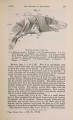
Show 228 MR. F. H.WELCH ON LEPUS AMERICANUS. [Apr- 8, Society's ' Proceedings' for the same year (page 557). In that paper I described a new Frog, which I proposed to name Pachybatrachus robustus. I now find that, by a singular coincidence, the very same generic term was applied about the same time by Professor W . Keferstein, M.D., of Gottingen, to another new Batrachian. This appears in the third number of the 'Archiv fiir Naturgeschichte' for 1868, where, at page 273, Professor Keferstein has published a description of his Pachybatrachus. I therefore beg leave to withdraw the name which I before gave, and to substitute for it the more appropriate term Clinotarsus. I propose therefore that my new Frog should bear the name C L I N O T A R S U S R O B U S T U S. 2. Observations on Lepus americanus, especially with reference to the Modifications in the Fur consequent on the rotation of the Seasons, and the Change of Colour on the advent of Winter; based on Specimens obtained in the province of N e w Brunswick, North America. By F R A N C I S H . W E L C H , Assistant-Surgeon, 1st Battalion, 22nd Regiment*. This species is the sole representative of the Leporidee in the province of N e w Brunswick. In the List of Mammalia of the Portland Natural-History Society it is called the "White Hare," and in the 'New York Fauna,' by De Kay, the "Northern Hare." It is also termed the "American Varying Hare," and was for a long time confounded with the L. variabilis of Europe. Its geographical range appears as yet undetermined. According to Sir John Richardson it " is found as far north as 64° 30', Fort Enterprise, forming the staple food and clothing of the Hare Indians on the banks of the Mackenzie River." Its southerly limits are given by De Kay as " the northern parts of Pennsylvania and the mountain-tops of the northern part of Virginia." Of the many species oi Leporidee inhabiting the North- American continent, it appears to be the only one that undergoes a complete change of colour during the winterf,-the Greenland Hare remaining white during the whole year, L. nanus becoming of a lighter hue, and occasionally iron grey, during the winter months, and L. glacialis assuming occasionally in the adult a greyish tint during the summer, limited to the points of the hair, the deeper parts remaining white permanently, the young, however, being born grey, and changing to white on the advent of winter^. Its weight varies-in its southernmost limits reaching 6| lbs. ; in N e w Brunswick averaging 3 lbs.; in Hudson's Bay Territory 4 lbs. * Communicated by Mr. G. Busk, F.R.S. t i. e. provided the L. campestris be only a variety of L. americanus, as stated by Sir J. Richardson, but denied by Baird. \ Fauna Boreali-Aimericana. |