| OCR Text |
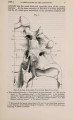
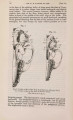
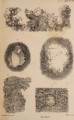
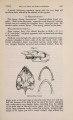
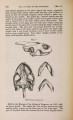
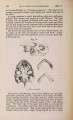
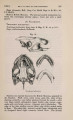
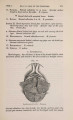
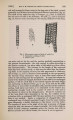
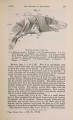
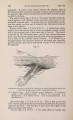
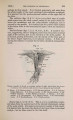
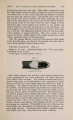
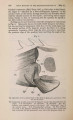
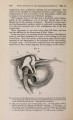
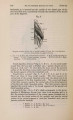
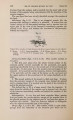
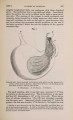
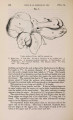
Show 24 MR.W. H. FLOWER ON THE [Jail. 14, outer division, in which is the opening of the eustachian tube (e), an inner one, of which the anterior end is a cul-de-sac, as in Felis; but this septum only extends through about one-fourth or one-third of the entire cavity, so that the two chambers communicate most freelv. In the hinder part of the inner chamber are a few irregular projecting bony ridges. The bulla is developed as in the Cats, from two parts, an outer true tympanic, and an inner cartilaginous portion. At birth ossification has not commenced in the latter, and appears in the former only as the horseshoe-shaped tympanic ring. The carotid canal (car) is complete, and of tolerable dimensions ; but its external opening is not visible on the surface of the bulla, being deep in the foramen lacerum posticum (I); the course of the artery is similar to that which it takes in the Bears. The paroccipital process (p) is long and prominent; and its anterior surface is applied closely to the back part of the bulla, but to a less extent than in the Cats, as the process is more compressed. The mastoid (m) is distinct, but slightly developed. The condyloid foramen (c) is conspicuously situated on the ridge passing from the paroccipital to the condyle, and is quite distinct from the foramen lacerum posticum (1). The glenoid foramen (y) is very large. The alisphenoid canal (a a') is present. It is clear that, with these cranial characters, which are found distinctly developed (with some modifications to be noticed hereafter) in all the members of the family Canidee, the Dogs cannot be placed in either of the great primary groups as above defined. They are in fact as nearly as possible intermediate between the two. The general form of the bulla and the presence of a septum, though imperfect, incline to the iEluroid type; while the position and development of the carotid canal, of the condyloid foramen, and of the glenoid foramen are Arctoid characters. The form of the paroccipital and mastoid processes, and the length of the meatal lip, are intermediate. Though I agree with Mr. Turner in making the Dogs a distinct primary group, which might be termed C Y N O I D E A , I differ from him in placing them at one end of the series and the Bears at the other. The Dog appears to m e to be the most central or generalized form of the whole order as at present existing, at least as far as the structure of the cranium is concerned. The comparative length of the folded caecum is a special peculiarity*. The reproductive organs belong neither to the Arctoid nor to the iEluroid type, but partake of some of the characters of each. In the absence of Cowper's glands, and * The length of the caecum in the Dogs, among other characters, induced De Blainville to place them at the end of the series of which the Bears were at the head, the Cats, with moderate caecum, intervening. But may not the long caecum be rather a retention of general mammalian structure, which has been completely or partially deviated from in the Bears on the one hand, and the Cats on the other both more specialized groups ? It should be remarked that the Dogs retain more nearly the typical number of teeth than any other Carnivores, and that some of the earliest known forms of the order appear, as far as can be gathered from their fragmentary remains, to belong to the group. Thus the Early Miocene Amphicyon had the teeth of a modern Dog, with an additional upper molar, completing the typical mammalian dentition. |