| OCR Text |
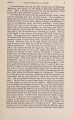
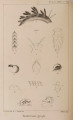
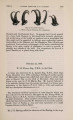
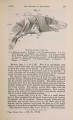
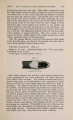
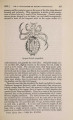
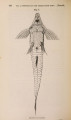
Show 1869.] LETTER FROM MR. G. CLARK. 3 A communication was read from Mr. George Clark, of Mahe'burg, Mauritius, Corr. Memb., on the Squill of Mauritius (Squilla styli-fera). After a detailed account of the external characters of this group, Mr. Clark proceeded to observe as follows : - " The Squills are mostly nocturnal animals, living in holes ; hence it is not surprising that they are little known. It is evident at a glance that the position of their branchial apparatus renders it impossible for them to carry their eggs as Lobsters and Shrimps do; such an arrangement would stop their breathing. Cuvier states that he never saw one bearing eggs; and it was with no small satisfaction that, while making researches on the history and habits of these creatures, I learnt from Dr. Power he had seen this ; aud a few days after I had the satisfaction of witnessing it myself. The roe of the Squill is very curious, and occupies the whole length of the body. The eggs when first extruded form a compact mass, which the female holds between the three pairs of jaw-feet. As this mass expands it forms a loose kind of tissue, somewhat similar to a fleece of wool. Little by little, as the eggs enlarge, the texture of the mass becomes looser, until the larvae are hatched and swim off to shift for themselves. In the first period of incubation, if I may so call it, the female will hold her eggs even when caught; but'the further advanced they are the more readily does she drop them, possibly on account of their cohering less firmly. I believe the female must fast while carrying her eggs; for I have found the stomachs of those taken at that period quite empty, but generally full at other times. When first hatched the larvae are of a delicate yellowish green, and are very active. As they grow they assume a mottled grey, and the swimmerets and legs become pea-green. The green gradually increases in brightness ; but it is not till they have reached a length of three inches that the colours of the adult appear. The male is then of a beautiful bluish green, with the jaw-feet, the swimmerets, and the branchiae, as well as the antennae and the fimbriae which border the different organs, of a cherry-red. The female is clouded with brown and grey, presenting much the appearance of tortoiseshell, and the red about her is much less vivid than in the male. The young Squills inhabit holes in the sand, near low-water mark. The old ones are never found here, but reside in the patches of coral which are scattered over the shallows. Both old and young have invariably two entrances to their holes; and the adults always stop these with a plug of fine seaweed. They do not swim swiftly; and in places where the water is not deep enough for them to swim their principal organs of progression are their large jaw-feet, which they thrust forward as a man would do striving to get along on the points of his elbows. I believe these limbs also serve them to make their holes, as they are often considerably worn on the joints. The motions of the Squill are very different from those of a Shrimp or a Lobster, being much more like those of a caterpillar; hence the little Creoles call the young ones ' Chenilles de mer.' The extensor muscles seem to act much more powerfully than the flexors; and it is by the former that the vigorous motion is produced which inflicts |