| OCR Text |
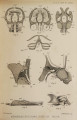
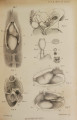
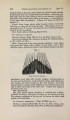
Show 484 DR. MURIE ON FREGILUPUS VARIUS. [Julie 16, outward sweep and extension of the neighbouring ridge and tubercle, capacity of the femoro-articular facet, large shelf for fibular shaft-abutment, inferior intercondyloid osseous bridge, as well as strength of the entire bone, altogether denote a muscular power of leg adapted to terrestrial more than climbing or perching habit. This limb-strength is likewise well expressed in the tarsus, whose robust triangular shaft is deeply furrowed to accommodate the tendinous cords. The calcaneal eminence is drilled by five foramina. The inferior mid-digital knuckle is largest and longest, the outer laterally compressed, and about equal to the inner, which has an oblique set. for the reception of the goodly-sized metatarsal element. The foot has the more usual phalangeal numbers 2, 3, 4, 5, and is |-toed, the ungual phalanges being strong and curved. The 2nd and 4th digits are subequal in length, the 3rd considerably longer than either, the 1st or hind toe of medium length, but by far the stoutest of all. SUPPOSED ALLIANCE TESTED BY THE SKELETON. With the Upupida.-In my communication upon these birds in ' The Ibis' I indicated why, osteologically, Fregilupus can no longer be accorded a place among that group. Indeed Levaillant's, Vieillot's, Hartlaub's, and SchlegeFs determination, from exterior characteristics alone, are sufficient proof of distinctness from the Hoopoe tribe, and as such accepted by the later classific writers on ornithology. To what I have hitherto stated (/. c), if I add the Passerine feature of multiple calcaneal foramina, the totally different nature of the mandible, notwithstanding its mask of elongation and slenderness, the humerus with its large, bifid pneumatic openings, its round, not flattened, shaft and condylar tubercles, the differentiated distal bones of both wing and leg-then surely such multiplicity of evidence denotes that the skeleton of Fregilupus trenchantly recedes from the Hoopoe members, and, as to be shown, correspondingly draws towards the Starling family. With the Sturnida.-The genera of this family, with which I have compared each separate bone side by side with the subject of my paper, are Sturnus, Pastor, and Gracula. Taking these in the order mentioned, that of the Common Starling, £. vulgaris, precedes. With this species of Sturnus, Fregilupus agrees in the general pattern of the sternum ; but the former has more delicate xiphoid bars and relatively larger spaces, a deeper keel and longer rostrum, a narrow pointed angular, and not broad rounded scapula. In Sturnus the antiliac blades and ischial production are relatively shorter than in Fregilupus. With reference to the lower jaw, the type of both is manifestly similar, and in this respect very unlike the preceding groups. The postarticular angle is more acuminate in the Starling, the symphysial, or so-called dentary, region relatively deeper, broader, and shorter than in the Reunion bird. Again, in the cranium both exhibit a certain fulness of brain-region, but wanting the bilobed character of Upupa ; in the latter the interorbital breadth is great, |