| OCR Text |
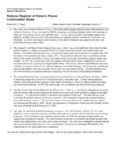
Show OM B NO. 1 024-00 18, NPS Form United States Department of the Interior National Park Service National Register of Historic Places Continuation Sheet Section No. § Page ~ Grafton Historic District, Rockville, Washington County, UT Dedicated in January and finished at the east end of North Street in the spring of 1862, 22 with Dr. Samuel Kenner being the teacher. The schoolhouse was used for all public gatherings. It was a round log house with two windows and a door in it. The windows were very small; also were the window panes. The floor was of slate rock which was hauled and placed in the room for the floor. The benches were of the logs sawed in two; the round part holes were bored and 23 pegs driven in for legs. ~ ",~J,.. ~ ~~ ~ ~ J..w,,"~ ~ ~ ~,,~ ~ GL.~oSI.,.~cJ...~\.e.I(\\.~ ~~~\'JI.\ N~<:;~ Prior to this, all church and public m etings had been held in Alonzo H. Russell's Parge canvas tent, which he had purchased from Johnston's Arm . 24 Early on, a mud pit was excavated to the southwest of the extant David and Maria Ballard House for t e purpose of making adobe and soft-fired bricks. These were used to build permanent structures, as good hardwood was not plentiful in the valley. Crops and Other Trades In an attempt to better fulfill the primary purpose of their mission, the farmers at Grafton produced a record (1f;7~ pounds of cotton in 1862,25 at the expense of raising food crops. They subsequently replaced a portion ~ cotton crops with corn to ensure that there would be enough to eat, and in 1863 and 1864 they planted sixteen acres of wheat, seventy acres of corn, twenty-five acres of sugar cane, ten and one-half acres of 26 vegetables and tobacco, and twenty-nine acres of cotton. By 1866 the breakdown of crops had chan~ed to twenty acres of wheat, forty-five acres of corn, eight acres of sugar cane, and eighteen acres of cotton. 7 They also planted cherry, peach, apple and pear trees in early 1862, along with grape and currant bushes. The fruit was dried or bottled and then taken to the northern settlements with molasses to be bartered for 28 potatoes, cheese and dry goods. After the fruit trees began to produce large harvests and each family had more than they could process, the practice of cutting bees became popular. Many of the women and girls would gather together at one house and cut and layout all of the fruit to be dried. Afterwards they would play games and eat watermelon and grapes. 29 By 1864 the town had a sawmill, a gristmill, a thresher and a cotton gin. These machines, along with the farming tools , required maintenance. Alonzo H. Russell had been a successful blacksmith in Salt Lake City and continued his invaluable trade at Grafton. He provided the community with knives, forks, tongs, hand irons 3D John WOOd, and hammers as well as repairing broken wagon parts, sharpening plows, and shoeing horses. Sr., was also a blacksmith, but his carpentry skills earned him the responsibility of making much of the furniture 31 in town . Eventually John Wood , Jr} ook over his father's blacksmith shop. /' On January 16, 1864, the Territorial Legislature created Kane County, and Grafton was chosen as the county seat. At this time a statistical census of the church counted twenty-eight families and 168 people in Grafton, 22 Jenson . History of Grafton Ward, 1862. Biography of Sarah Jane York Tiffany, p. 8. 24 Lyman D. and L. Karen Platt. Grafton: Ghost Town on the Rio Virgin , p. 62. 25 Bleak, op. cit. , p. 128. 26 Platt, op . cit. , pp. 64-5. 2? Bleak, op . cit., p. 230. 28 McMullin , op . cit. , p. 21. 29 Grant Langston, Memories of John Langston , p. 60. 30 Ballard , op. cit., p. 21 . 31 McMullin, op. cit. , p. 3 23 Almira Tiffany Bethers. , |