| OCR Text |
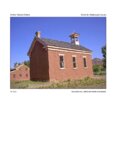
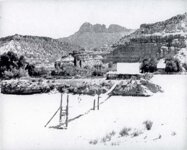
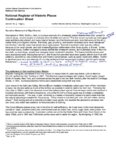
Show NPS Form 10-900-a Microsoft Word 2.0 Format OMB No. 10024-0018 United States Department of the Interior National Park Service National Register of Historic Places Continuation Sheet Section No. 8 Page 14 Grafton Historic District, Rockville, Washington County, UT payment in cash and 75% in stock (land). The canal and dam were finally finished in August, 1904. The 1910 census showed that ten families, totaling forty-four people, from Grafton had relocated to Hurricane. By 1920 those numbers had more than tripled to thirty-two families with 138 people. As families left Grafton they took their houses with them whenever possible. George Henry and Emily Hastings Wood moved their log home to Hurricane prior to 1910, having been stockholders in the canal company. Henry's nephew Andrew moved his house and barn (located east of the extant John, Sr., and Emily Wood house) along with his family to Hurricane, as well, in 1911 .44 The last people to leave Grafton were Minnie and LuWayne Russell, and Edward D. and Rhoda Ballard Jones45 who owned the John, Sr., and Emily Wood house from 1920 until the spring of 1945. In 1944 the Joneses bought a two-room log cabin from Merrill and Agnes Russell that was located east of the Alonzo and Nancy Russell adobe home. They took the cabin with them when they moved to Rockville in the spring of 1945.46 Grafton and the Movie Industrv Grafton was the filming location for a number of movies beginning in 1929 with 'The Arizona Kid." Several of the local residents, including Vilo and Floyd DeMille, earned four dollars a day working as extras. "Ramrod" was filmed in 1947 with Joel McCrea and Veronica Lake, and several temporary buildings, including a hotel to the west of the schoolhouse, were constructed for the set. The ruins of one building can still be seen atop the stone foundation of the William and Sarah Hastings House (Site #14). "Butch Cassidy and the Sundance Kid," starring Robert Redford and Paul Newman, was set at Grafton in 1969. A small frame house was constructed at the southeast corner of East and North Streets and was later accidentally burned down by campers. "Child Bride of Short Creek" was the last Hollywood movie filmed at Grafton in 1981. Today the town stands as a tribute to the men and women who built it and kept it alive for more than eighty years. The cultural resources that still remain are in varying stages of deterioration, but many of the buildings are fairly sound. Grafton is significant as a unique example of a frontier settlement that survived the hardships of the hostile and untamed West, yet was abandoned in the mid-twentieth century without having been significantly altered. The buildings appear largely as they did when they were erected, except for the effects of time and neglect. Unlike Grafton, other Mormon missionary settlements were either quickly abandoned, leaving very few visible remains behind, or they thrived and continue to survive today in a much altered state. Grafton should be preserved as an unparalleled example of a nineteenth-century frontier town. --1Lsee continuation sheet 44 Wood, op. cit., p. 1. 45 According to Vilo Jones DeMille, daughter of Edward and Rhoda. 46 Platt, op. cit. , p. 111. |