| OCR Text |
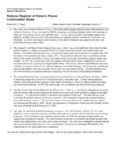
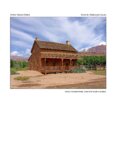
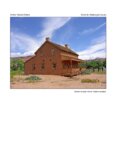
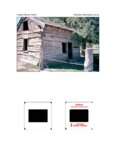
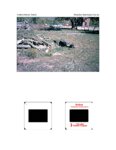
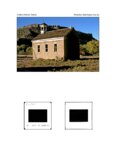
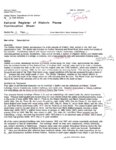
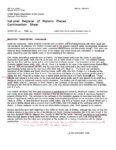
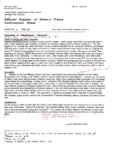
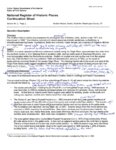
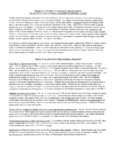
Show OMS No.1 024·0018, NPS Form United States Department of the Interior National Park Service National Register of Historic Places Continuation Sheet Section No. ~ Page 1. Grafton Historic District, Rockville, Washington County, UT to Hyrum and Mercy Barney's home (possibly a wagon) where she gave birth to a b()y. In celebration of the event she named the child Marvelous Flood. 19 The winter and spring ·o f 1862 were devoted to digging the new irrigation ditch, clearing and fencing the land, and planting crops. The location and depth of the trenches were such that residents 'Were able to get water during the wet season, but by May the river was too low to fill the ditches, 20and the irrigation system had to be modified. Ultimately the ditch cost $5,000 and the labor of twenty-four men?1 By summer, the ditches were sufficiently watering the corn, sugar cane, wheat and cotton that had been planted in the spring. A log schoolhouse/meeting house (demolished) measuring eighteen by twen1:y-six feet was Dedicated in January and finished at the east end of North Street in the spring of 1862,22 with Dr. Samuel Kenner being the teacher. The schoolhouse was used for all pub lic gatherings. It was a round log house with two windows and a door in it. The windows were very small; also were the window panes. The floor was of slate rock which was hauled and placed in the room for the floor. The benches were of the logs sawed in two; the round part holes were bored and pegs driven in for legs.23 Prior to this, all church and public meetings had been held in Alonzo H. Russell's large canvas tent, which he had purchased from Johnston's Army, which occupied Utah during the Mormon War and then abandoned the territory when the Civil War started. 24 He lived in the tent with his two wives and children until his one-and-ahalf story adobe house was built the following year but also hosted community dances in the tent. Alonzo Haventon Russell (1821-1910) was a polygamist, following the Mormon custom of the time, and two wives lived in Grafton with him?S They were sisters from New Hamlshire, Nancy Briggs Foster (1825-1903) and Louisa Maria Foster (1839-1917), and each had nine children. 2 Alonzo H. Russell was born in Vermont and was a musician, expert on the drums and fife.27 Russell lived in the house until his death and members of the Russell family occupied it until 1945. William Hastings (1824-1882) and Sarah Smith (1830-1920) were both English Mormon converts and came to Grafton after the 1861 "call." They had eight children together, five of whom were born in Grafton. Sarah Smith Hastings lived in her house on the southwest corner of Grafton Road and North Street as a widow for her last forty years. The house's foundation is still visible. John Harvey Ballard (1825-1891) and his wife, Charlotte Pincock (1826-1901), married in Nauvoo, Illinois, in 1845, and after some time of living in Provo, Utah County, were "called" to Grafton, settling there in the early 19 Ibid. , January 18, 1862. 20 Ibid. , May 19, 1862. 21 James Bleak. Annals of the Southern Utah Mission, p. 1234. History of Grafton Ward, 1862. 23 Almira Tiffany Bethers. Biography of Sarah Jane York Tiffany, p. 8. 24 Lyman D. and L. Karen Platt. Grafton: Ghost Town on the Rio Virgin , p. 62. 25 AncestralFile. 26 Ibid. 27 Platt & Platt, p. 26. 22 Jenson. |