| OCR Text |
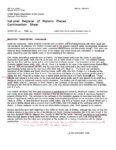
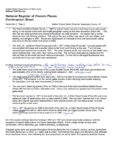
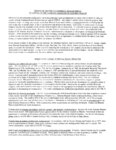
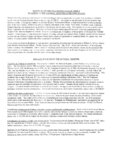
Show OMS No. 10024-0018 NPS Form 10-900-a Microsoft Word 2.0 Format United States Department of the Interior National Park Service National Register of Continuation Sheet Section No. -1L Page ~ s~ ent Slgnlnflc.ance, of Historic Places Grafton Historic District, Grafton, Washington County, UT contlnll e.,d ... \.o.ev.~ The river could also drop so low that it resembled a meandering stream. Even the well--engineered irrigation system had its limitations, and the farmers worked extremely long and hard for their moderate harvests. For example, Thomas Woodbury, the nurseryman who initially stayed at Grafton because Franklin Wheeler Young gave him a good farming lot, left after two planting seasons because the cut worms ate all of the buds on his fruit trees every spring, and the red ants and gophers destroyed what the cut worms did not. 41 The final and perhaps largest blow that led to the abandonment of Grafton was the construction of the Hurricane Canal. With a shortage of farm land for the younger generations, the Hurricane Bench, approximately fifteen to twenty miles downstream, was ripe for cultivation, but it was too high above the river to be irrigated with a common ditch. Greater measures would have to be taken, and the Hurricane Canal Company was organized on July 11, 1893. Each stockholder would be entitled to twenty acres of farmland up on the bench, thus providing plots for approximately one hundred young'?men. Wages for the construction workers were set at $2.00 per day, a signif[:ant step up from the money they could make at Grafton, although most of the workers took 25% of their payment in cash and 75% in stock (land). The canal and dam were finally finished in August, 1904. The 1910 census showed that ten families, totaling forty-four people, from Grafton had relocated to Hurricane. 42 By 1920 those numbers had more than tripled to thirty-two families with 138 people. As families left Grafton they took their houses with them whenever possible. George Henry and Emily Hastings Wood moved their log home to Hurricane prior to 1910, having been stockholders in the canal company. Henry's nephew Andrew moved his house and barn (located east of the extant John, Sr., and Emily Wood house) along with his famil{ )o Hurricane, as well, in 1911. 43 The last people to leave Grafton were Minnie and LuWayne Russ~y, and ~ward D. and Rhoda Ballard Jones 44 who owned the John, Sr., and Emily Wood house from 1920 untaf/ ~ring,;) 1945. In 1944 the Joneses bought a two-room log cabin from Merrill and Agnes Russell that was located east of the Alonzo and Nancy Russell adobe home. They took the cabin with them when they moved to Rockville in the spring of 1945. 45 Grafton and the MOYie Industry Grafton was the filming location for a number of movies beginning in 1929 with "The Arizona Kid." Several of the local residents, including Vilo and Floyd DeMille, earned four dollars a day working as extras. "Ramrod" was filmed in 1947 with Joel McCrea and Veronica Lake, and several temporary buildings, including a hotel to the west of the schoolhouse, were constructed for the set. The ruins of one building can still be seen atop the stone foundation of the William and Sarah Hastings t-bUS\ "Butch Cassidy and the Sundance Kid," starring 0t'L tt ~ J ---1Lsee continuation sheet 41Thomas H. Woodbury. Letter to the Domestic Gardeners' Club, Deseret Ne ws, 42See Appendix . 43Wood, op. cit. , 44 According to Vilo Jones DeMille, daughter of Edward and Rhoda. 45Platt, op. cit., y 'lll. %1. February 2, 1863. |