| OCR Text |
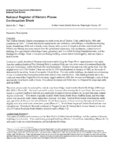
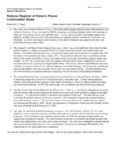
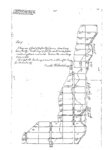
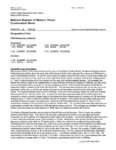
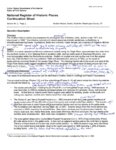
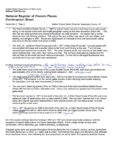
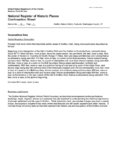
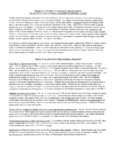
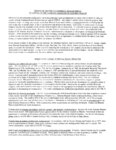
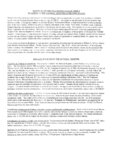
Show OMB No. 1024·0018, NPS Form United States Department of the Interior National Park Service National Register of Historic Places Continuation Sheet Section No. § Page ~ Grafton Historic District, Rockville, Washington County, UT 16 for a time. The residents also petitioned and received from the Territorial Legislature $1,500 to build a wagon road from Grafton to St. George and improve and extend the road from Harmony to Toquerville. 17 The road to St. George was an extension of South Street that followed the Virgin River to the west. The road from Harmony to Toquerville was most likely the present-day State Route 17. In May of 1861 Church President Brigham Young and several other presiding elders visited Dixie to assess the progress of the Cotton Mission. They were surprised to find the population very small, in spite of Young' s past efforts to settle the region. Upon their return to Salt Lake City they asked for volunteers to move south. After just one man offered to go of his own free will, President Young drew up a list of missionaries to be assigned the task. John Harvey Ballard, John Wood, Sr., William Hastings, and Alonzo Haventon Russell were among the Elders "called," or assigned, to Grafton at this time, and their families would subsequently be among the longest-standing residents of the town. Flooding and the Move to the New Grafton Settlement On December 17, 1861 a survey was completed for the new location and farming lots were drawn by lottery. There were more people than lots that resulted in several families leaving old Grafton before the move. This shortage of suitable farmland would ultimately be a contributing factor in the demise of the town. We drew for our farm lots oflottery[sic]. I got avery good lot but bro. Woodbury, a nursery man, got a very poor one and was going to move away, but I wanted him to stay, as I knew it would help the place to have a good nursery here, so I let him have my lot and I took his. In the evening we had a dance in bro. A.H. Russell's big tent. The remarks of bro. Snow has [sic] caused a spirit of uneasiness [sic] in the minds of many, and now those who did not get lots are about moving out, in fact, I may say and that truly although I do not find a bit of fault with what bro. Snow said, yes, it has drew at least one half away from the place and Rockville too, and has almost killed both places. 18 History has traditionally held that the settlers decided to move the town after a rain storm and flood that started on Christmas Day of 1861 and lasted forty days and nights; however, Franklin W. Young's journal clearly stated that, while the river did rise approximately four feet on December 25 th , there were seven days of fair or cloudy weather and four days of snow during the subsequent forty days. Furthermore, his diary, along with the minutes of the December 13, 1861 , ward meeting, prove that the decision to move the town was made at least a month before the "big flood." During the early hours of January 18, 1862, the rising water carried away one of Nathan Tenney's houses and its contents and destroyed another. His wife, Olive, who was nine months pregnant at the time, was washed from the house and caught in the river. All of the men were called out of bed to save her, and they carried her 16 This town was called both Grafton and Wheeler by its residents , but eventually after the other "Grafton" was abandoned, this settlement was solely referred to as Grafton . History of the Grafton Ward. 1861. 18 Franklin Wheeler Young . Journal, Wednesday, December 18, 1861. 17 Andrew Jenson. |