| OCR Text |
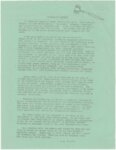
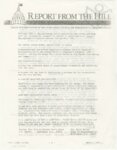
Show Services Committees to the floor of each house sometime in May or June. The defense authorization bill addresses policy issues, such as ASAT testing and SALT II, and also sets spending ceilings on individual defense programs, such as the SDI. The bill then goes to a c·o nference committee to work out the differences between the House and Senate positions. The House and Senate Appropriations Committees begin marking up the defense appropriations bill about the same time that the defense authorization bill goes to conference, usually in July. Defense appropriations can be lower, but no higher, than the authorized ceilings. Depending on the success, or failure, of arms control amendments to the defense authorization bill, action may be anticipated on amendments to the defense appropriations bill in the full House and Senate sometime in July or September. STAR WARS Early Deployment -- SDI proponents within the Administration, including Secretary of Defense Caspar Weinberger, appear to be anxious to commit the United States to deployment of either a partial or nationwide ABM (anti-ballistic missile) system before President Reagan leaves office in January of 1989. Regardless of the Administration's position, however, the final decision to commit to SDI deployment can be made only if Congress approves an SDI budget and a program for early deployment -- and such proposals are likely to face majority opposition in both houses this year. In a February 1, New York Times article, entitled "Beware of Phase I of SDI", Senator Albert Gore (D TN) may have voiced the emerging majority opinion when he wrote, " ... Congress is simply not going to follow the President down the road to early deployment of strategic defenses and to its inescapable corollary, early abrogation of the Anti-Ballistic Missile (ABM) Treaty." Key Votes Expected -- The "proof of the pudding" is in the voting. A major test of .Senator Gore's prediction will come when Congress considers the FY '88 defense authorization bill. The · League is urging Congress to reduce spending for the SDI below last year's appropriation, instead of simply limiting the rate of increase. The Administration has requested $5.9 billion for the SDI, a 67 percent increase over last year's level of $3.5 billion. Representative Charles Bennett (D FL), who sponsored last year's successful effort to freeze SDI spending in the House, is expected to offer an amendment to reduce SDI spending this year as well. Bennett, a senior member of the House Armed Services Committee, has already indicated that he would support a level below last year's appropriation. Senators Bennett Johnston (DLA) and William Proxmire (D WI) are expected to lead the effort to reduce SDI spending in the |