| OCR Text |
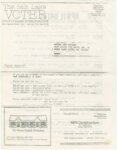
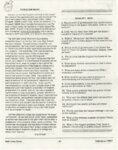
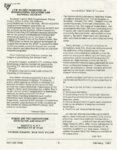
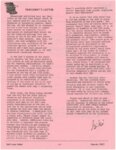
Show the-core"'ot 11· t'.s more complex than the old QU~S.. ,ii, twn of guns or butter, but the chokes the budget battle frames are evefi bit as fundamental. President Reagan submitted rJs Fis~ cal Year 1987 (FY 87) budget proposal to Congress in early February amidst predictions that it was "dead on arrival. 1• ln~c.ations are that there was nothJng premature about that diagnosis---that the budget that finally emerges from Congress this year will bear little n:· &emblena: to Reagan's. Still his n-.:quest will help shape tl1e debate. The areas of disagreement are nu.. merous. Painted broadly. the President ~s requesting large increases in defonset c;:';mm-R~d~;,m ar;.. At yearly deficit targets~ progressively re• dudng and~ by 1990, eliminating the def- • icit and a series of ''automatic'' budget cuts in the event that those ta, gets are not met. Hit comes to that. the automatic cuts ,vill be detemuned by fonnulas contained in t.¾e law, leaving comparatively little discretion to Congress or the President to apportion the cuts. f\l nuntL'!.-t:r 01 do1ucstK p, u grnmh v.:t.'. H:~ exempted from the aut,Jmatic cuts, Those im.:iudt• Social Si;. ·rnrily t Aid tu Famili~s with Dependent Children (wel~ fare), food stamps, Medicaid and in" terest on the. national debt. But a number of other programs were not. Strategic Defense Initiative. He ilrO·· • poses t.o pay for those increases· not with a tax hilie, but rather \.Vith further ~uts to the very domestic programs that have suffered s.o bad!y in the first five years of h.is Administration. 87 budget that meets the 1987 deficit target of $144 billion. In that processt everything is on the table for negotia~ tion, including those programs exempted 0 No • rnngrcssionaJ l~~;rsYalu'm'-"i1l low-er irHt:rcst. paynu...nts on Uw dd>L The goYermnent h.is borrmn·d money at an agreed n:itt: of inkr est and those paymtnts must made. Likev.ise. a numlkr of contracts have Ltt:n cph:red into ui.:urcvious y,:.m, that span the current fiscal year. In essence cancelling such contracts would cost a~ much as continuing them. Expem:.iiture!i on entitlement pro~ gr ams vary depending on how many dti- zens qualify and how much they each receive. Cutting expenditure levels would require statutory changes in the pmgrams--changes that would either cut benefits or reduce eligibility. Of the remaining expenditures (24.3 The most immediate impact of Gramm.-Rudman is that it puts tr~n1en~ perce~t of the_ ~veraU budget). 60 per~ dous prt:.ssure on Conbrress to pass a FY c~~t ts for mibtary expenses ($160.2 induding another _sharp hike for bfa from alltomatic cuts. The deliberations are .complicated still billion)-mostly salaries and operating exnens.es. - The remainina 40 ~rcent of "controllable'' expenses (ll percent ot~e overall budget} is for non--entitlem~nt domestic programs, such as Amtrak subsidies. General Revenue Sharing Adding still more confusion t.o the farther by Gramm-Rudman--HoUings, problem is a pending Supreme Court S<Halled •tdeficit reduction act" • •• decision on the constitutionality of the am fTll\r'A :'a.~;t\ed in the dosing hours of ConBy the end of FY 86, the deficit is mechanism for enacting the automatic j;ress's December session. cuts (see Court Notes, page 7). Shouid expert~d to top $200 billion, That rep , The outcome of the 1986 budget bat• the Court rule against the new law, Con- resents more than a fifth of the overall '.;1e ¥<rill hinge on a number of factors~ grt!ss would be left with its ()Id prob- • federal budget So, given the President's •··,duding, the effect of Gramm-Rudlem--too many bills to pay and too few refusal to raise taxes, what would need man-Hollings on .the process, the Presi• to be cut to balance the hudgt't is far , dollars to pay them. dent's adherence to his no-tax/more~de" in short, Gramm-Rudman has made more ~han could be saved even if all .iense hard line and the success of grass~ toots efforts to stress the importance of -- th~~ ye~(s RUdget baide a high•stakes, ; ~~n~n~Jemer::t domestic programs w~re . . ou~i, . game of congressional t h1ckcn. wm i , peedcd domestic spending. •,~ even more pres~mg Congress flinch and affept the Presi- : I P e p~o bs1.causc ~he t/•-!ll<ft:H~ n~!~ muy refus_es denfs budget as a means of avoiding Gr.mtm-Rudmar~-Hoih~~: to cut defon~e. b~t m~a~ts on .an m~ the Gramm~ffodman automatic cuts? staJu.:s congressmrud dm:ken creas~: Coupled wtth his mtranslge~ce When Congress passed the Gramm-Rud-1 · Will the Presldent compromise on de" th ~n. ra~Smglr~ve~u~~ !oug~ taxe:i, Just man-Hollings ddicit reduction ac4 fense or on 2 tax increa se? Or v,:iH b~th 1 the ~87 hn_e wi~hl. -t_!dde.tctt __t,·r-ig ~ir,,.U t"nn _•Nm.Ima.n's and vlait ft_)r_Grarmn ,-cl_ ho_-M tig. ht. 1 fo._r sh.ort, it was lookmg_ Cr&nn1-Rud_r_nar_ w1 1 r•~qu•r.-:. tarupt rnan .rramm1 • • • .. • • . ,. ·... ; • "· • es- ·."' • •• _l()o ,. _ !h , nd to kKk m! of soc~ autoirnahr: ,or .a way out 01.1 the yearly t~at tmy nonenqtlekmg LH::y ~ ~ssivcly Lari,er deficits. 'foe past five _1 . ment don~estac port1,Jfl of tht.~budgt.:t .So . ·_ years have ~en tht· ff·deraJ debt - ile u i " ·.•--- -the President has focused on entitle•1 -d . A • . P ;_: P !be budget sq_~uce1.e _ ··d t • . . . . . at a r.M.' unprel'.e en.e in mencan ,!JS· ··~ tory. With the future"of th~ mfon's eco- Cutt.mg the oudget i.s sum{•·thmg almn~t • ments as weiL The Reagan cuts nomy hant.'lllg in the balance, Congress every?ne suppQrts m the abstract. J_t s [n total the President proposes to cut choosmg thc programs to cut th al dd,cs detcmuned itself to acL $22 billion from domestic spending, . . . But the very forces that drove the conSensus. spread out over a number of prngrams. Anol t'r comphca! 10 n !S th ci 1 much of l)udget into ddicil in the first place make th More than 40 programs would be ~ kdcrai budget smiµly cann~)t b~: rut. solving the problem so difficult Put sirneliminated. These include: piy, the natio.'1 is living beyond its means, l'!early th n:(••fourt hs u~ speo<lmg m the ~/' Amtrak subsidit::; while almost everyone !avors balanc• r y HG r;,udget ss. rlai~~;1fa·d -as "tmcon· :ing the budget~ it•s always ·someone troHabJc ----th~tt is H falls mtu mw of Appalachian Regional Commission three rcHegones: eJse•s program that should be cut. Community Developmt!nt block ' So Congress turned to an approach C) interest on the Hiitionat dl•bl, grants {e.g. oblig,1tiom, th.".lt would effectively tie its hands in CJ rnntracts and otht/r the process: mandatt: cuts without as.. alH•ady signed rnns11w.:tion contrncts}, or if Economic Development Adminis · t:rntfon a entitlt~ments such as food stamps. •ii,i.&rning political responsibility for them. ··/ Gcrn~ral Revenue Sharing wdt.:irc:·. S-orit! S,~l ~,nt y ,;nd ot ht-r~. J Ju\·enilc Justice Assistance - 14 SAL T LAKE VOTER 0 l mg.n.. i 1~h~ - m h |