| OCR Text |
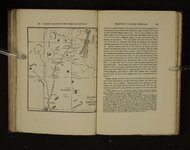
Show 266 LEADING FACTS OF NEW MEXICAN HISTORY EARLY In the course of this march to the Rio Bravo they passed through a province inhabited by the Conchos Indians, who lived in villages, the houses of which were made of straw. All of the inhabitants of these villages gave the Spaniards a cordial welcome. These people wore very few clothes, going about almost naked. Their government was about the same as that of the other Mexican Indians. They were agriculturists and raised great quantities of corn, gourds, squashes, and melons of fine quality. From the Rio Conchos they brought to the Spaniards fine fish which were enjoyed exceedingly. Their principal articles of diet were rabbits, jack-rabbits, and bears, the last named being very plentiful. They were killed by the Indians in great numbers. The Indians were not idolatrous, nor was any form of religious worship found among them. The Spaniards erected crosses, the natives making no objection, and the friars explained to them the meaning of the cross and how it was an emblem of religion. The Indians told them of other towns of their nation twenty leagues down the river, and conducted them thither. The chiefs sent word, one place to another, in advance, and upon the arrival of Espejo, the inhabitants were waiting to receive him. Leaving the Conchos Indians, Espejo arrived among the Passaguates, their immediate neighbors, who lived in much the same manner as the Conchos. The Spaniards remained with them but a short time, and were accompanied by the Indians further down the river, a four days’ march. In passing through this country, they found indications of silver mines, but made no effort to prospect them, although some of the company, who were posted on such matters, pronounced the ore very rich. Continuing their march they came to the land of the Tobosos, whose inhabitants fled to the mountains on the approach of the Spaniards. In later years, these Toboso Indians rivalled the Apache in cruelty, making many raids, and giving as reason that they had received very bad treatment at one time from a party of Spaniards, seeking slaves in their country. After leaving the mouth of the Conchos, the Spaniards passed into the country of the Patarabueyes, or Jumanos,?*? who, like the 282 Hodge, F. W., Handbook of American Indians, vol. i, p. 636. <A tribe of unknown affinity, first seen, although not mentioned by name, about the beginning of 1536 by Cabeza de Vaca and his companions in the vicinity of the Conchos, at its junction with the Rio Grande, or northward to about the south boundary of New Mexico. They were next visited in 1582, by Antonio de Espejo, who ealled SPANISH EXPLORATIONS 267 Tobosos,*** were hostile at first, attacking the Spaniards killing some horses, and afterward fleeing to the mountains. They, afterwards, having been approached by the Spaniards through interpreters, listened to explanations, receive d gifts feonl them Jumanos and Patarabueyes, stating that the numbered i i lages along the Rio Grande from the Soil ination Runige mart hihi Journey. Most of their houses were built of sod or earth and grass with fiat roofs 5 they cultivated maize, beans, calabashes, ete. When visited in 1598 by Juan de Ofate, who called them Rayados, on account of their striated faces, a part at least of the Jumanos resided in several villages east of the Rio Grande in New Mexico, the four principal ones being called Atripuy, Genobey, Quelotetrey and Pataotrey. From about 1622 these were administered to by the Franciscan Fray Juan de Salas, missionary at the Tigua pueblo of Isleta, New Mexico. In response to the request of 50 Jumanos who visited Isleta in July 1629, pendent mission, under the name of San Isidoro, was established among 268 The Tobosos were evidently a very prominent an indethem in and a very warlike tribe of Indians: They first appear in the Relacion of Espejo at page 167. He calls them Tobozos. He states that they were shy and shiftless: ‘‘Son esquiPe y aSi Se fueron de todas las partes que estaban pobladas, en Xacales, por ree pasabamos sustentase con lo que los dichos Pazaguates; usan = arcos y flechas ; andan sin vestiduras; pasamos por esta nacion que parecia aber pocos Indios, tres jornadas, que habria en ellas once leguas.’’ ‘ Mr. Bandelier, Final Keport, note, p. 82, in writing of this tribe, says: ; raspar Castafio de Sosa, who marched from Nuevo Leon to New Mexico ay makes no mention of the Tobosos in his Journal. Neither does Juan de ree mn ae his Diary of .1596. The Tobosos were, then, to be found mainly in and Nuevo Leon, and also in Tamaulipas. They became formidable be lhuahua only in the seventeenth century, after missions had been estabished and the contact with civilization gave some pretext for depredations. I i pretext, for in most cases, as with the Apaches, for instance, such tribes rc for some opportunity to resort to murder and rapine. In his Carta ae Orozco y Berra localizes, so to say, the Tobosos in Coahuila and i Pah ta It seems certain that they most habitually infested those diseure c they were also a terrible scourge in Chihuahua, On the whole, it a. Je as difficult to assign to them a definite territory as it would be to the 1630. a in former times, previously to their reduction to reservations. In huis e a Alonzo de Benavides mentions again the Tobosos, Memorial que Fray an bee hagerg de la Orden de San Francisco, Comisario General de Indias, Mad aa. i Majestad Catolica del Rey don Felipe Cuarto Nuestro Senor, ten of at p. 7. He speaks of the Tobosos along with a number of other aetna uhuahua, like the Tarahumares, Sumas, Janos, etc., and says of them till lin eat y: Gente muy feréz, barbara, y indomita; porque andan siempre iii td desnudosin tener casa, ni sementera alguna, viven de lo que cacan, ‘i eel ae ks 000 genero de CeIros a otros; animales, aunque y sobre el juego sean inmudos, mudandose para esto suelen estas naciones tener guerras ‘ate matan brutalmente. sus armas son arco y flecha, que son las generales a, ‘48 naciones,’ Miao. of the Jesuit missicns in Mexico, P. Francisco Xavier Alegre, eres se e obosos, speaking of their first appearance as fomenters and leadi Pine Dn guypohghkeapedh ns contiguous tribes, Historia de la Compania de Jesus gentes b oe” vol. ii, p. 244: ‘Comenzaron las hostilidades por los tobosos, los fo encosas y barbaras, y que servian como de asilo 4 todos Tagidos y mal contentos de aquellas provincias. Los robos y las muertes |