| OCR Text |
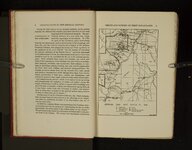
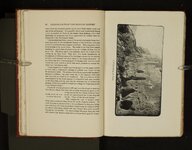
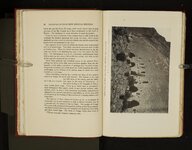
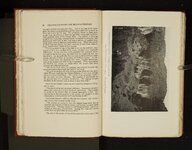
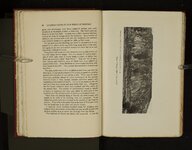
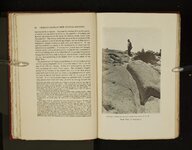
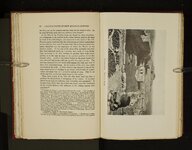
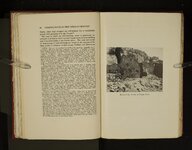
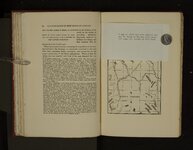
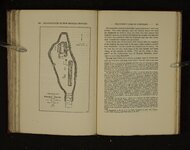
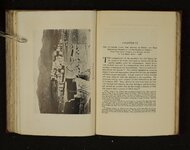
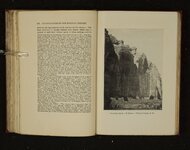
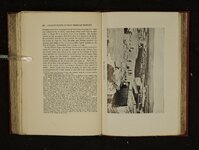
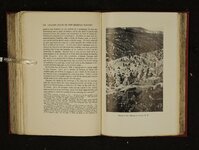
Show ORIGIN AND HISTORY OF FIRST INHABITANTS 17 have no Indian name. The great potrero on which the ruins are situated, and the valley to the south of it, are known by the Spanish name Chupadero. The main pueblo is a quadrangle about one hundred and twenty feet square. Near by are three smallhouse ruins and a reservoir. In the cliff wall below are hundreds of excavated rooms. ‘The settlements above described seem to have been rather The villages are all connected by well-worn trails, closely related. One crosses the mesa of Pi-nin-idepth. unusual of them of some can-gwi. Uren me Eeay T \ pee ae | i With one exception it is the deepest worn rock trail that I have ever seen. It seems to have been made entirely by the attrition of human feet, being so situated that its depth could not be augmented by water erosion. The net-work of trails to be seen over this entire plateau is one of its most interesting archeological features. The trail is a sharply cut path, usually about eight inches wide, from a few inches to a foot in depth and in many places more. The path narrows but little toward the bottom and is remarkably clean cut. A large part of the surface of the plateau is rock devoid of soil, and these paths afford an imperishable record of ages of coming and going. The well-worn stairways are worthy of particular notice. ‘The Pu-yé is a fine example of the ancient Pajaritan community. At this place is found everything that is characteristic of the Pajaritan culture; every form of house ruins, typical in construction and placement; sanctuaries, pictographs, implements, utensils, symbolic decoration, all following a well-defined order, and conforming in all essential particulars to a type of culture to which I have for present convenience given the name Pajaritan. ‘“The Pu-yé settlement was made up of two aggregations of dwellings: 1. The great quadrangle on the top of the mesa, an arrangement of four huge terraced community houses about a court, forming at once an effective fortress and a capacious dwelling ; a compact residential fortress that might not inappropriately be called the citadel; 2. The cliff-villages, consisting of a succession of dwellings, built against and within the wall of the cliff, usually at the level where the talus slope meets the vertical escarpment. The latter will be described first. The cliff is more than a mile in length. We note here three classes of dwellings: 1. Excavated, cave-like rooms, |