| OCR Text |
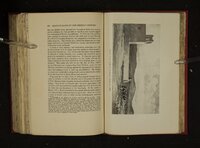
Show JOURNEY TO CIBOLA 153 age, for at this point he raised a heap of stones and placed at the top a small cross and formally took possession of the country in the name village alone corresponds substantially with the settlement friar, and that Zufii traditional accounts of events which centuries evidence. Mr. ago are not worthy of consideration as described occurred historical by the over three or scientific ‘‘TIn order that there may be no difference in terms employed I will recite Bandelier’s own translation from the Spanish of the description of the Cibolan village seen by Niza when he took possession in the name of the king of Spain of the territory now forming Arizona and New Mexico. ‘Reviewing that portion of the friar’s narrative relating to his desire to continue onward to Cibola, after the death of Estevan and some of his companions, Mr. Bandelier says: ‘His Indians were unwilling to accompany him, They not only resisted his entreaties, but threatened his life, in atonement for He pleaded and remonstrated, the lives of their relatives slaughtered at Cibola. but they remained stubborn. At last two of their number, ‘‘ principal men,’’ he says, consented to lead him to a place whence he could see Cibola from afar (then quoting Niza): ‘‘ With them and with my Indians and interpreters, I followed my road till we came in sight of Cibola, which lies in a plain on the slope of a round height. Its appearance is very good for a settlement, the handsomest I have seen in these parts. The houses are, as the Indians had told me, all of As far as I could see from a height stone, with three stories and flat roofs. where I placed myself to observe, the settlement is larger than the City of . Here again, in sight of Cibola (now continues Bandelier), his Mexico. ’’ Indian guides re-iterated the statement that the village now in view was the the seven, and that Totonteac (Tusayan) was much more importof smallest one After taking possession of Cibola, Totonant than the so-called Seven Cities. teac, Acus and Marata for the Spanish Crown, raising a stone heap, and placing & wooden cross on top of it, with the aid of the natives, and naming the new land the ‘‘New Kingdom of St. Francis,’’ the friar turned back, ‘‘with more fright than food,’’ as he very dryly but truthfully remarks.’ ‘“The natural approach to Zuii from the southwestward, the direction whence Niza came, is by way of the Little Colorado and Zufi river valleys. Any other route from that direction tremely difficult of travel would lead by reason through a region of its broken of utter desolation, and arid character. ex- The valley through which Zufi river flows on to the Little Colorado part of the year, abundant is easy to travel, and it may be reasonably assumed that water was at or within easy reach of the sandy river bed when Niza’s little foree wended its way toward Cibola, late in May of the year 1539. To have left the valley would have increased the distance which the barefooted friar must traverse, It therebesides leading him over an indescribably dreary and rugged stretch. by the valley fore would seem that Niza, as well as Estevan, approached Zui Toute over which Coronado, guided by Niza, went a year later, a route leading directly to Hawaikih, the southwesternmost of the Cibolan towns, and one of the two largest of the group. From Southwestern foot of Taaiyalone the southwest Ki-ak-i-ma, which lies at the or Thunder Mountain, in the eastern part of Moreover, route alluded to. the plain, can be reached only by the tortuous pueblos when approached Ki-ak-ima was the most remote of all the Cibolan from the southwest, Matsaki alone excepted. been Niza’s object in _ ‘In the light of these facts, then, what wo uld have who eviVisiting Ki-ak-i-ma, particularly when guided by unwilling natives, before reaching the dently had visited Cibola before? Had he made a detour of viewing Ki-ak-i-ma from the adjacent vicinity of Hawaikah for the purpose |