| OCR Text |
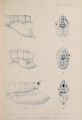
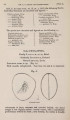
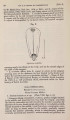
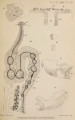
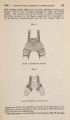
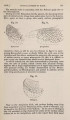
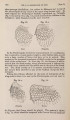
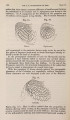
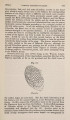
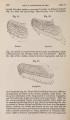
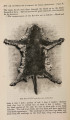
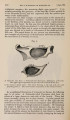
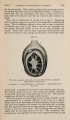
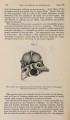
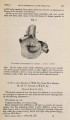
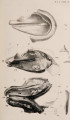
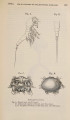
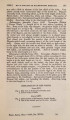
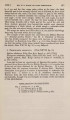
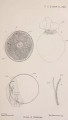
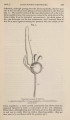
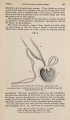
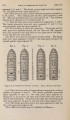
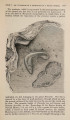
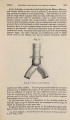
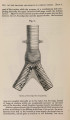
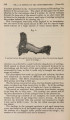
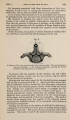
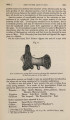
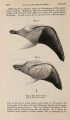
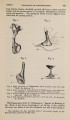
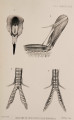
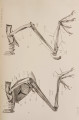
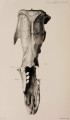
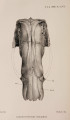
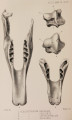
Show 406 MR. A. SMITH WOODWARD ON THE [June 29, other cranial elements in a more or less well-preserved state. Among the latter are two long bones with expanded extremities, lying lengthwise, one on either side of the basi- and presphenoids; and the form and situation of these elements, considered in connection with the evidence of other specimens presently to be noticed, can leave no doubt that they are the homologues of the columella (epipterygoid, Parker) found in Lacertilia, Rhvnchocephalia, Ano-modontia, Dinosauria1, and Chelonia. The bone on the right shows a side view, while that on the left is seen either from behind or before, and although both are fractured to a certain extent, their boundaries are readily distinguishable. The right columella is 0*045 metre in total length, and is shown of the natural size in fig. 1 2 (p. 407). The upper end exhibits a triangular expansion, which, before fracture, must have measured about 0*016 metre in greatest breadth ; and the long terminal upper border thus produced has a gently arched contour. Immediately below the expanded portion the bone becomes much constricted, having a diameter of only 0*003 metre, and at the distance of 0019 metre from the lower extremity it commences again to widen, but here in an unsymmetrical manner. From the upper expansion downwards the anterior edge is nearly straight, but at the point just mentioned the hinder edge rapidly curves backwards, until the bone attains a maximum breadth of 0*012 metre, when the border once more descends almost vertically for some distance, and finally curves to the front. The lower end, however, has evidently been much crushed, like the remainder of the bone, and perhaps does not give an exact idea of its original shape. The left columella, presenting only an anterior (or hinder) view, does not add any further details to the foregoing description ; but this side of the fossil is of especial interest, since, as pointed out to me by Mr. G. B. Howes, there appears to be some indication of a downwardly-directed process of the parietal to meet the columella, such as exists in the living Cyclodus3. There is no indication of the fusion of the upper end of the bone with the parietal (or ? "squamosal"), such as Prof. Cope describes (/. c. p. 204) in the American form. In a skeleton of Ichthyosaurus from the collection of the late Prof. Tennant (No. R 44 of the B.M. Register), the postorbital and adjoining bones are so far removed and displaced as to permit an admirable view of the lower end of the right columella, which is uncrushed, and still in contact with the pterygoid immediately behind the orbit. This is shown of the natural size in fig. 2. Its front edge is almost vertical, but curvgs slightly forwards near the lower termination, and there is a sharp anterior outer ridge along the whole length of the bone. The expanded portion exhibits a 1 See O. C. Marsh, " Restoration of Brontosaurus," Amer. Journ. Sci. (3) vol. xxvi. p. 83; "On the Diplodocidas," ibid. (3) xxvii. p. 163; "The Order Theropoda," torn. cit. p. 332. 2 The drawings have been made by Mr. W . H. Hill. 3 T. H. Huxley, ' Anatomy of Vertebrated Animals,' p. 189, fig. 69. |