| OCR Text |
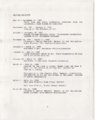
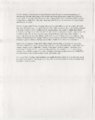
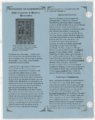
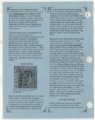
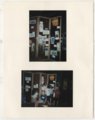
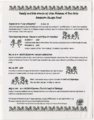
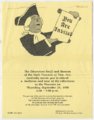
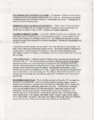
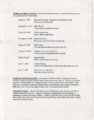
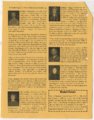
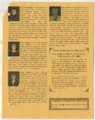
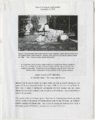
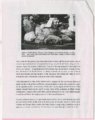
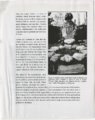
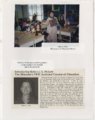
Show STEERING COMMITTEE MEETING There will be no Steering Committee Meeting this month. OOPS!!! Kathryn Miller's real telephone number is 9444948 ~OTLIGHT ON EXHIBITIO~ Our theme for the Winter PAJR.'fner's exhibition is multiculturalism. Highlighted are objects from five cultures that are the focus for our PAJR.'fners tours as well as objects from the Middle East. ~he themes for the five cases are Textiles, ume, Beadwork, Sculpture and Masks. ~ MEET THE COLLECTOR Bert Cliff will talk about the new promised gifts to his collection of Chinese Ceramics currently on view in Gallery 3 on February 22 at 2:00 p.m. rsPOTLIGHT ON OBJECT~ A new groups of Chinese ceramics from the Bert G. Cliff collection will be in the small temporary exhibition gallery (Gallery 3) through March 15. It is widely accepted that porcelain was first made by Chinese potters toward the end of the Han period (206 BC- AD 220), when pottery generally became more refined in body, form and decoration. The Chinese made early vitreous wares (proto-porcelain) before they developed their white vitreous ware (true porcelain) that was later so much admired by Europeans. Porcelain appeared when feldspathic material in a fusible state was incorporated into a stoneware ~omposition. The ancient Chinese called decaye~ feldspar "kaolin" (meaning "high place," f r o ~ where it was originally found); this substan;;i is ~JI known in the West as china clay. Petuntse, or china stone, a less decayed, more fusible feldspathic material, was also used in Chinese porcelain; it forms a white cement that binds together the particles of less fusible kaolin. Significantly, the Chinese have never felt that high quality porcelain must be either translucent or white. Two types of porcelain evolved: "true" porcelain, consisting of a kaolin hard-paste body, extremely glassy and smooth, produced by high temperature firing, and soft porcelain, invariably translucent and lead glazed, produced from a composition of ground glass and other ingredients including white clay and fired at a low temperature. The latter was widely produced by eighteenth-century European potters. The origin of glazes and glazing techniques is unknown, but the fine lustrous glazes developed in China surely began with a simple glaze that served to cover earthenware and render it watertight. Chinese potters used two kinds of glazes, one composed basically of feldspar, and another produced by fusing silica of quartz or sand by means of a flux, generally of lead oxide. Chinese potters regarded glazes and glazing techniques as having prime importance; under the Han emperors, they made great efforts to improve this technology. The use of lead glaze increased, and wood ash was incorporated in its composition, imparting a brown or gray-green coloring, somewhat blotchy and occasionally, iridescent. These effects were entirely natural as no coloring matter was added to the composition. Glazing techniques were modified under successive dynasties. Colored glazes were developed and used to brilliant effect by T'ang and Song (Sung) potters, and a great diversity of brightly hued wares appeared over the centuries. Many connoisseurs, however, feel that the pure white porcelain, called "blanc de chine," which ~irst appeared during the Ming dynasty, is t h ~ |