| OCR Text |
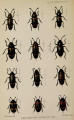
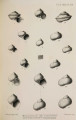
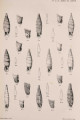
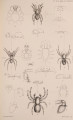
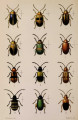
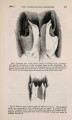
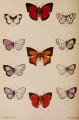
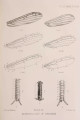
Show 1883.] M. JACOBY ON NEW SPECIES OF BEETLES. 405 part of the face fulvous. Antennae fulvous or piceous. Thorax transverse, narrowed from the base to the apex, the sides nearly straight and longitudinally flattened ; surface very finely punctured at the disk, the latter black, the sides with a metallic green gloss. Scutellum black. Elytra rather convex, slightly but distinctly widened towards tbe apex, very closely punctured, the interstices finely rugose, of a metallic green or blue colour. Entire underside and the legs fulvous. Hab. East Africa (coll. Jacoby); Zanzibar (coll. R. Oberthur). Closely allied to P. smaragdina, Clark; but at ouce separated by the black colour of the thorax and of the scutellum. The elytra show no trace of longitudinal costae as is sometimes seen in the allied species. The present insect is also larger, and the antennae are more filiform. The specimens contained in my collection and in that of M. Oberthur are all females. I may further add that the thorax of P. smaragdina is much more strongly punctured, and that Clark gives the colour of the entire insect as metallic green or aeneous, which is a mistake, the underside being of the same colour as that of the present insect. SYSTENA, Clark. 12. S Y S T E N A DISCOIDALIS, sp. nov. (Plate X L V . fig. 12.) Elongate, flavous; head and thorax impunctate ; elytra extremely finely punctured, their posterior two thirds black, the latter not extending to the margins. Length 3^ lines. Hab. Ecuador. Head entirely impunctate; the frontal tubercles rather obsolete and divided by a very shallow groove ; carina indistinct; lower part of face depressed. Jaws black at their apex. Antennae half the length of the body, filiform, entirely pale fulvous; all the joints, with the exception of the short second one, of nearly equal length. Thorax nearly twice as broad as long, subquadrate, the sides obliquely shaped, forming a distinct angle before the middle; anterior and posterior angles rather rounded; surface with a rather deep transverse sinuate groove in front of the base, the sides of which are gradually lost near the lateral margins ; disk impunctate. Scutellum broadly triangular. Elytra wider than the thorax, subdepressed, slightly widened towards the middle, with a shallow sutural depression below the base, very fiuely and closely punctured, flavous, with an oval-shaped black patch extending from below the base to the apex, but leaving all the margins of the ground-colour. Posterior femora moderately thickened; their tibiae with a distinct spine. A single specimen, collected by Mr. Buckley, contained in my collection. From the typical species forming the genus Systena, which are known to me, the present one deviates somewhat by the rather deep thoracic groove, the peculiar coloration, and its size; in all other structural characters, including the closed anterior coxal cavities, it agrees with the rest. |