| OCR Text |
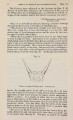
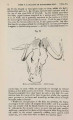
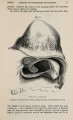
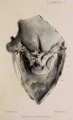
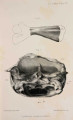
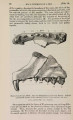
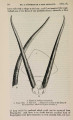
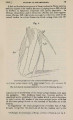
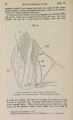
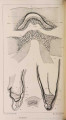
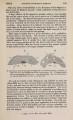
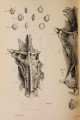
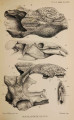
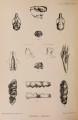
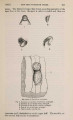
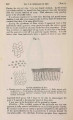
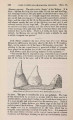
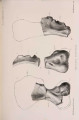
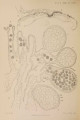
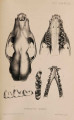
Show 1889.] MR. O. THOMAS ON A N E W GENUS OF MURID.E. 249 lobe of ^ is slightly folded inwards at its centre. Lower incisors very long, their front surface white. Lower molars (fig. 4) as in Hydromys, but the walls of the large anterior lobe of mJ are notched, so as to give a rather more cuspidate character to the tooth. Dimensions of the type, an adult female in spirit:- Head and body 111 millim. ; tail 85 ; hind foot 23*2 ; ear 10X 10*5 ; head 33 ; forearm and hand 29 ; heel to front of last foot-pad 10*8 ; length of last foot-pad 2*6. Skull.-Basal length 26 ; greatest breadth 15 ; nasals, length 8*9, breadth 3*3; interorbital breadth 5*0; interparietal, length 3*1, breadth 9*2; infraorbital foramen, length of outer wall 2*8, distance from outer corner of one foramen to that of the other 7*6 ; palate, length 16, breadth outside m.1 5*5, inside m.1 2*1 ; diastema 9 ; length of palatine foramina 3*9 ; length of ^f 2*8, of TOOJ 1*5 ; of the two together in situ 4*1. LLab. Port Mackay, Queensland (Godeffroy Museum). The above given being the combination of characters presented by the new form, we may turn to the interesting questions as to the phylogeny of Hydromys naturally raised by its discovery. Had the origin of Hydromys been formulated apart from Xeromys, it would most assuredly have been somewhat as follows :-The ancestor of Hydromys would have been said to have been an ordinary Murine with three molars, which took to an aquatic life as Mus fuscipes, Microtus amphibius, and others have done, and that then, afterwards, as the external characters became modified for swimming, and as some water-loving substance was more and more exclusively used as food, the teeth became modified in the remarkable manner characteristic of the genus. This natural speculation, apparently quite sound in itself, is abruptly overthrown by the discovery of Xeromys ; for that animal, without having developed the aquatic habits and characters of LLydromys, has already attained to the same specialized dental peculiarities. That Xeromys is the almost unmodified descendant of one of the more recent direct ancestors of Hydromys is almost unquestionable, as it does not possess a single peculiar character of its own, every one of its points being present either in its relatives the true Rats and Mice, or in what we may fairly call its offspring, Lfydromys. The true course of the evolution of Hydromys appears therefore to have been this. There would have been living in Australia, perhaps comparatively recently, one or more species of a terrestrial genus possessing a Murine exterior and skull, and Hydromyine dentition, palate-ridges, and mammae (»". e. Xeromys as now defined). Some members of this genus taking to an aquatic life, such of their characters as had any direct relation to the power of swimming would have become modified, these being size, form of head, and therefore of skull, structure of muzzle (for cleaving the water and keeping it out of the mouth), great whisker development, closeness and glossiness of fur, extra folds on ear-conch, webbing of toes, suppression of sole-pads, and hairiness and increase in size and strength of tail. On the other hand, the number and structure of the teeth, and even such slight and presumably easily modified |