| OCR Text |
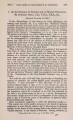
Show 1882.] ANATOMY OF PROTELES. 581 The sterno-hyoid muscles differ from those of Hyana inasmuch as they are inseparably united so as to form a single muscular band from their origin to their insertion. Proteles differs in a corresponding manner from Viverra, in which the two muscles are quite distinct. The omo-hyoid is absent in Proteles as in Hycena. In the latter genus Meckel1 affirms its presence in H. striata; but in H. crocuta it is certainly absent. The stylo-glossus of Proteles agrees with that of Hycena, but differs from that of Viverra inasmuch as it is attached to the base of the stylo-hyal bone. In Viverra it is attached to the middle in length of that bone. In Proteles the stylo-hyoid is absent, as in Hyana crocuta and in Viverra. In H. striata Meckel affirms its presence. The scaleni are arranged much as in H. crocuta. As in that species the scalenus anticus is absent. The scaleni medius and posticus in Proteles are more closely united than in H. crocuta, aud form a single mass of fibres arising from the 4th, 5th, 6th, and 7th cervical vertebrae, and inserted into the four anterior ribs. A very slight separation exists between the fibres which are inserted into the first rib and the rest of the muscle. In Viverra there are three perfectly distinct scalene muscles. The splenius of Proteles exactly resembles that of H. crocuta. It differs from that of Viverra inasmuch as no part of its fibres is inserted into the cervical vertebrae. Thus in Proteles, as in H. crocuta, the splenitis colli is absent. In Proteles, as in 11. crocuta, the complexus is not divisible into a complexus proper and digastric. In this respect the two species named differ from H. striata. Muscles of the Back, Thorax, and Abdomen. The trapezius of Proteles resembles that of H. crocuta. In both these species it is relatively of much smaller size than in Viverra. The latissimus dorsi in H. crocuta arises from the posterior eleven dorsal spines, and has no costal origin. Similarly in Proteles the costal origin is wanting, and the spinous origin is limited to the posterior eight dorsal spines. A strong dorsi epitrochlearis exists in Proteles, as in H. crocuta. The insertion of the muscle into the humerus is rather higher in Proteles than in Hyana. The rhomboideus in Proteles, as in H. crocuta, is single. In the former it arises from the last four cervical and two anterior dorsal spines, and is therefore relatively larger than in H. crocuta. Meckel states that in H. striata this muscle possesses an occipital origin. Proteles in this respect differs from H. striata and agrees with H. crocuta. The serrati postici in Proteles are not continuous with one another as they are in H. brunnea and Viverra. In this respect Proteles agrees with H. crocuta. The serratus magnus of Proteles resembles that of H. crocuta, but takes an additional attachment to the first rib. In this respect Proteles differs from Viverra. 1 Anatomie comparee. |